Firefox no sound after an update is usually caused by reset autoplay permissions, an extension conflict, or a hardware acceleration glitch. These are the settings to check to get sound working again.
Most fixes take less than a minute, and you don't need to reset your entire browser. Start with the Autoplay permission and work your way down to a full Firefox refresh only if nothing else helps.
In this guide, I have covered:
Contents
Firefox No Sound After an Update: Why It Happens
You updated Firefox, opened a video, and the tab is playing, but no sound comes out. Firefox no sound after an update usually points to changed autoplay rules, a hardware acceleration conflict, or an extension that no longer works after the update.
Mozilla has also shipped audio fixes in recent releases, including a fix for silent streaming audio in Firefox 153.0.1, a fix for media failing to play from Blob URLs in Firefox 153.0.3, and a fix for live audio streams stopping in the background in Firefox 155.0.
The same updates that fix audio bugs can reset your autoplay preferences, disable a setting you rely on, or expose a glitch in an extension. The fixes below start with the most likely cause and move toward deeper resets.
Quick Checks You Should Do First
When Firefox goes quiet right after an update, spend a few seconds on the simple causes before changing settings. These checks take almost no time and fix more issues than you’d expect.
- Look at the tab that’s playing audio. If the speaker icon shows a slash through it, click the icon to unmute the tab.
- Click the speaker icon a second time and confirm the tab volume slider isn’t pulled all the way down.
- Check your operating system’s volume mixer. On Windows, right-click the speaker icon in the taskbar and open Volume Mixer. On macOS, open System Settings → Sound and confirm Firefox isn’t muted.
- Test a different website. If YouTube plays sound but your usual site doesn’t, the problem is site-specific, not Firefox-wide.
- Restart Firefox. Audio glitches from a partial update often clear after a full relaunch.
You’ll know one of them worked when audio starts before you change a single Firefox setting. If the browser is still silent, move to the Autoplay settings below.
Check Firefox’s Autoplay Settings
When Firefox loses sound after an update, the Autoplay permission is the first setting that explains most silent tabs. If the default changed to Block Audio or Block Audio and Video, every site will stay quiet until you allow it again. For a deeper look at how this setting works, see how to allow or block sound autoplay in Firefox.
- Click the
 menu button in the top-right corner of the toolbar.
 - Select Settings.
- In the left sidebar, click Privacy & Security.
- Scroll down to the Permissions section.
- Find Autoplay and click the button next to it.
- In the dialog that opens, check the dropdown under Default for all websites.
- If it is set to Block Audio or Block Audio and Video, change it to Allow Audio and Video.
- Click .
Reload the site and play the same audio. You’ll know it worked when the tab’s speaker icon shows no mute slash and sound comes through. If the dropdown was already set to allow audio, move to the next section.

You can also type about:preferences#privacy in the address bar and press to jump straight to the Privacy & Security panel.
Allow Sound for Specific Sites
If only one site stays silent while others work, Firefox may have stored a Block entry for that site. The exception list inside the Autoplay dialog shows every site with a custom permission.
- Stay in the same Autoplay dialog from the previous section, or reopen it: Settings → Privacy & Security → Permissions → Autoplay → .
- Scroll to the site list at the bottom of the dialog.
- Find the site that’s playing silently. If its status is Block, click the dropdown next to it.
- Change the status to Allow.
- Click .
- Reload the site and try playing audio again.
Reload the site and test audio. You’ll know it worked when the same site starts playing without a new Block entry reappearing. If it still plays nothing, the block is likely coming from an extension.
Run Firefox in Troubleshoot Mode
If Firefox still has no sound on every site, an extension may be interfering. Troubleshoot Mode restarts Firefox with all extensions and custom themes disabled, so you can test audio without them.
- Click the hamburger menu at the top right of Firefox.
- Click Help.
- Select Troubleshoot Mode….
- Click Restart in the confirmation dialog.
Play something on the site that was silent. You’ll know it worked when sound returns in Troubleshoot Mode but stays missing in a normal session. Open Add-ons and Themes and re-enable extensions one at a time, testing after each, until you find the culprit.
Test Sound in a Private Window
Still no sound after Troubleshoot Mode? Test the site in a private window. A private window loads a clean profile with no extensions, no cookies, and no cached data from your regular session.
If audio works there, the cause is an extension, corrupted site data, or a permission stored in your main profile. See how to open a private window in Firefox for the full steps.
- Click the menu button in the top-right of the toolbar.
- Select New Private Window.
- Visit the site where audio wasn’t playing.
- Try to play the video or audio track.
- If sound works here, the issue is in your main profile. Continue to the next section.
If sound works in the private window, continue to the next section to clear corrupted data from your main profile. If sound still doesn’t work, skip ahead to the hardware acceleration and system checks.
Clear Cookies and Cache
Corrupted cookies or cached media data can keep a site silent even when every permission looks correct. Clearing this data forces Firefox to fetch fresh media files the next time you load the site.
- Open the Firefox browser on your computer.
- Click on the More menu and select the Settings menu.
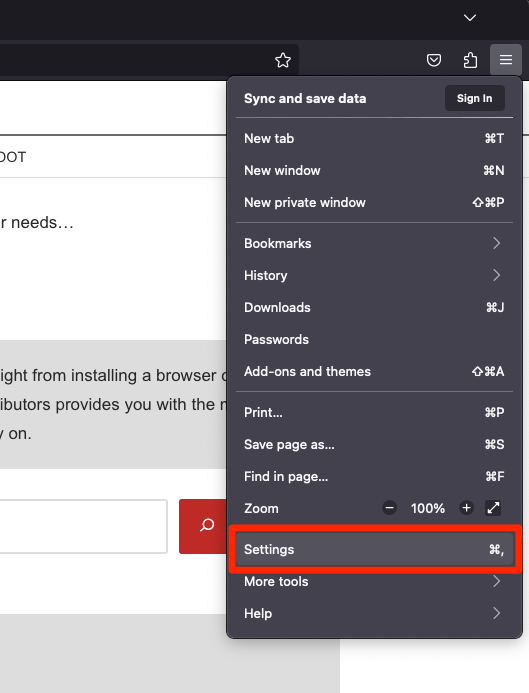
- Switch to the Privacy & Security tab and scroll to the Cookies and Site data section.
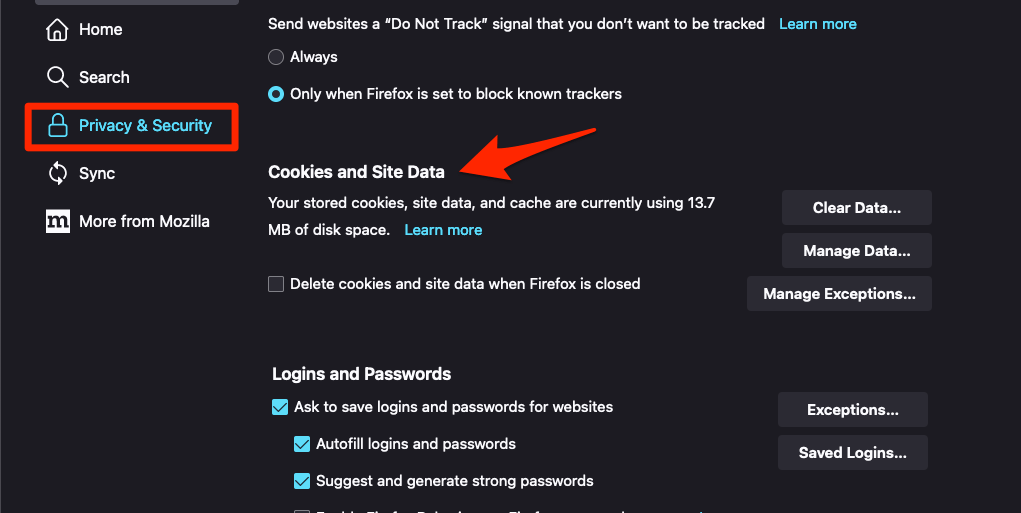
- Click on the button.
- Enable the checkbox for the 'Cookies and Site Data' and 'Cached Web Content' options.
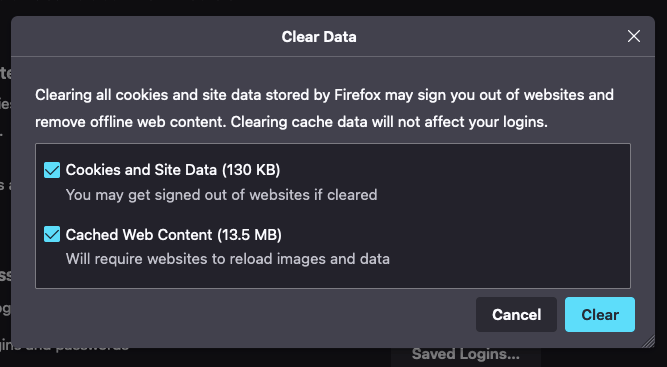
- Hit on the option.
It will immediately delete the cache, cookies, and site data on the browser.
Restart Firefox, sign back into the sites you use, and test audio again. You’ll know the cache was the problem if the same track plays after the data clears.

TIP: If you don’t want to clear all cookies, clear data for just the affected site. Open the site, click the padlock icon in the address bar, select Clear cookies and site data, then reload.
Toggle Hardware Acceleration
After a Firefox update, a GPU driver conflict can leave video playing but audio silent. Firefox uses hardware acceleration to offload media decoding to your GPU, and a driver change can break that path after an update.
Disabling hardware acceleration falls back to software decoding, which often restores sound immediately.
- Click the hamburger menu and choose , then select from the left sidebar.
- Scroll to the Performance section.
- If "Use recommended performance settings" is checked, uncheck it to expose the manual options.
- Uncheck "Use hardware acceleration when available".
- Restart Firefox from the hamburger menu so the change takes effect.
Play audio on the site that was silent. You’ll know it worked when sound returns immediately after Firefox restarts with hardware acceleration off. If it helps, leave the setting off or wait for a Firefox update that fixes the GPU driver interaction.
Reset Autoplay Preferences via about:config
If the normal settings look correct, a hidden autoplay preference may have changed during the update. Firefox stores some autoplay and media preferences in the advanced configuration page, and resetting the right one can restore audio.
- Type about:config in the address bar and press .
- Click when prompted.
- Type media.autoplay.default in the search box.
- Double-click the preference and set the value to 0 to allow all autoplay, 1 to ask for permission (default behavior), or 2 to block all autoplay.
- If the value was set to 2 (block), change it to 1 or 0 and test audio.
- Close the tab when finished. Firefox will use the new value immediately.
You’ll know it worked when the silent site starts playing after you set media.autoplay.default to 1 or 0. If the value was already 1, this preference is not the cause.
Only change the preferences listed here. Other about:config entries can break Firefox or affect your privacy if set incorrectly.
Refresh Firefox
When every lighter fix fails, a corrupted preference left by the update is the likely cause. Refresh Firefox resets your settings, extensions, and site preferences to their defaults while keeping your bookmarks, passwords, browsing history, and open tabs intact.
- Click the hamburger menu , choose , then select .
- On the Troubleshooting Information page, find the Give Firefox a Tune Up section on the right.
- Click Refresh Firefox and confirm by clicking in the dialog.
- Wait for Firefox to restart. Your bookmarks and logins are preserved, but extensions and most site settings are reset.
After Firefox restarts, test audio on your usual site. You’ll know it worked when the same page plays sound immediately. If sound is back, re-enable your extensions one at a time so you can identify any that were causing the conflict.
Check Your System Sound Settings
If Firefox is still silent after all the browser-side fixes, the operating system is the next suspect. A Windows or macOS update can reset audio drivers, output devices, or per-application volume settings at the same time as your Firefox update.
On Windows, right-click the speaker icon in the taskbar, select Sound settings, and confirm the correct output device is selected. Then open Volume Mixer and make sure Firefox isn’t muted or set to zero volume.
On macOS, open System Settings → Sound → Output and confirm the right device is chosen. Then open Audio MIDI Setup (in Applications → Utilities) and check the format and sample rate match your audio device.
Restart your computer after checking these settings. If audio still doesn’t play, run your operating system’s audio troubleshooter or update your audio drivers from the manufacturer.
TIP: If sound works in every other application except Firefox, the issue is isolated to Firefox. Skip the system-level checks and focus on the Firefox settings above.

Frequently Asked Questions
Why did Firefox stop playing sound after the last update?
Firefox updates occasionally reset autoplay permissions, change how media is decoded, or interact with audio drivers differently. Mozilla has shipped several audio fixes in recent versions, so regressions from earlier updates are common and usually resolved in a follow-up release.
Will refreshing Firefox delete my bookmarks and passwords?
No. Refresh Firefox keeps your bookmarks, saved logins and passwords, browsing history, and currently open tabs. It resets settings, extensions, themes, and site permissions to their defaults.
How do I unmute a single Firefox tab?
Click the speaker icon on the muted tab. If the icon has a slash through it, Firefox has muted that tab specifically. Click once to unmute, or right-click the tab and select Unmute Tab.
Is there a way to test if an extension is causing the sound issue?
Yes. Open Firefox in Troubleshoot Mode: click the menu button, choose Help, then Troubleshoot Mode. That disables all extensions. If sound works there, re-enable your extensions one at a time to find the one interfering with audio.
What Firefox version fixes the most common audio bugs?
Recent releases have shipped several audio fixes: Firefox 153.0.1 fixed silent audio on streaming sites, Firefox 153.0.3 fixed media failing to play from Blob URLs, and Firefox 155.0 fixed live audio streams stopping in the background. Keep Firefox fully updated to receive these fixes.