When Firefox shows no cookies activated under Manage Data, or stops remembering logins, the cause is usually a setting, not a bug. Cookies and Site Data controls whether Firefox accepts, blocks, or deletes cookies, and Enhanced Tracking Protection can split them into per-site jars that look empty.
Work through the global cookies toggle, the delete-on-close checkbox, Enhanced Tracking Protection levels, per-site exceptions, the cache, Troubleshoot Mode, and a full Refresh in the order most likely to fix the issue.
In this guide, I have covered:
Contents
Why Firefox Shows No Cookies Activated or Cookies Not Working
You open Manage Data in Firefox on your computer and see no cookies, or sites keep signing you out and forgetting your preferences. The cause is usually a setting, not a bug. The Cookies and Site Data section under Privacy & Security controls whether Firefox accepts, blocks, or deletes cookies. Enhanced Tracking Protection can also split cookies into per-site jars that look empty in the list.
Before you change settings, match the symptom to one of three common causes. The global “Block cookies and site data” radio may be selected, so Firefox refuses to set anything. The “Delete cookies and site data when Firefox is closed” checkbox may be ticked, so every restart wipes the slate.
Total Cookie Protection may also be silently isolating cookies per site, so a cookie set by an embed on one domain is not visible on a different domain. If that is the symptom, allow cookies for the specific site rather than disabling the global cookie toggle. The same logic governs how cookies appear in the site info and permissions panel in the address bar.

Total Cookie Protection has been on by default in Firefox since the Standard Enhanced Tracking Protection level shipped. It keeps each site’s cookies in a separate jar, so a cookie set by an embed on one domain is intentionally not shared with another domain. That behavior is by design, not a failure of the cookies feature.
Make Sure Cookies Are Enabled in Firefox
If Firefox shows no cookies at all, the first check is the global cookies toggle. When that toggle is set to block, Firefox refuses to store anything, no matter what individual sites ask for.
- Click the hamburger menu
 in the top right of Firefox and choose Settings.
 - Select Privacy & Security from the left sidebar.
- Scroll down to the Cookies and Site Data section.
- Confirm the selected radio option is "Accept cookies and site data from websites (recommended)" and not "Block cookies and site data".
- If it was set to block, change it to accept, then close and reopen the affected tab.
Reload the page that was losing its state. If it still fails, the next likely cause is the “Delete cookies and site data when Firefox is closed” checkbox directly below.
Stop Firefox From Deleting Cookies on Close
When Firefox deletes cookies every time it quits, each new session looks like cookies were never set. That checkbox is the second thing to check when you are signed out immediately after restarting.
- Click the hamburger menu at the top right of Firefox and choose Settings.
- Select Privacy & Security from the left sidebar.
- Under History, change Firefox will to Remember history if it is not already selected.
- If you use custom settings, untick Clear history when Firefox closes.
- Click Settings… next to it and untick Cookies in the popup list.
- Restart Firefox once for the change to take effect.
Sign in again to the site that was forgetting you. You’ll know it worked when you quit Firefox, reopen the site, and remain signed in.
Reset Enhanced Tracking Protection to Standard
Firefox’s Enhanced Tracking Protection (ETP) controls how aggressively the browser blocks cookies, trackers, and fingerprinters. Strict and Custom levels can break sign-in flows on sites that rely on third-party cookies. That is the next common cause when cookies stop working on a single domain.
- Click the hamburger menu at the top right and choose Settings.
- Select Privacy & Security on the left.
- In the Enhanced Tracking Protection section, pick Standard.
- Sign in to Facebook and check whether the loop is gone.
Reload the affected site. You’ll know it worked when the page keeps you signed in without any per-site exception. If only one site is misbehaving, leave ETP at Standard and whitelist that site in the next step.
Turn Off Enhanced Tracking Protection for a Specific Site
When most sites work fine but one portal, learning platform, or embed-heavy page keeps forgetting you, the cleanest fix is to disable ETP only for that site. You do not have to weaken tracking protection everywhere.
- Open the website that fails to load in Firefox.
- Click the shield icon to the left of the address bar.
- Toggle the switch labeled "Enhanced Tracking Protection is ON for this site" so it moves to OFF.
- Wait for Firefox to reload the tab automatically, then try the page again.
Reload the site. You’ll know it worked when the shield icon to the left of the address bar shows a slash and the site keeps you signed in. Try the cookie-dependent action (sign in, save preferences) again.
Allow Cookies for a Specific Site (Manage Exceptions)
For a single domain that you want to allow or block on its own, the Manage Exceptions dialog lets you set a permanent rule that overrides the global setting. Use this when you know exactly which site is failing and want a precise fix.
- Click the hamburger menu in the top right of Firefox and choose Settings.
- Select Privacy & Security from the left sidebar.
- In the Cookies and Site Data section, click the Manage Exceptions… button.
- Type the full site address (for example, https://example.com) in the Address of website field.
- Set the Status dropdown to Allow.
- Click Save Changes, then close the dialog.
- Reload the site in the browser.
For the inverse problem, the matching block and allow guide for Firefox cookies walks through the same dialog with a Block status.

Clear Firefox’s Existing Cookies and Cache
A corrupted cookie for the current site can stop new cookies from being accepted, even when the settings above are correct. Clearing cookies and cache forces Firefox to re-fetch everything from the server. It also cleans out stale Manage Data entries for sites you no longer visit.
- Open the Firefox browser on your computer.
- Click on the More menu and select the Settings menu.
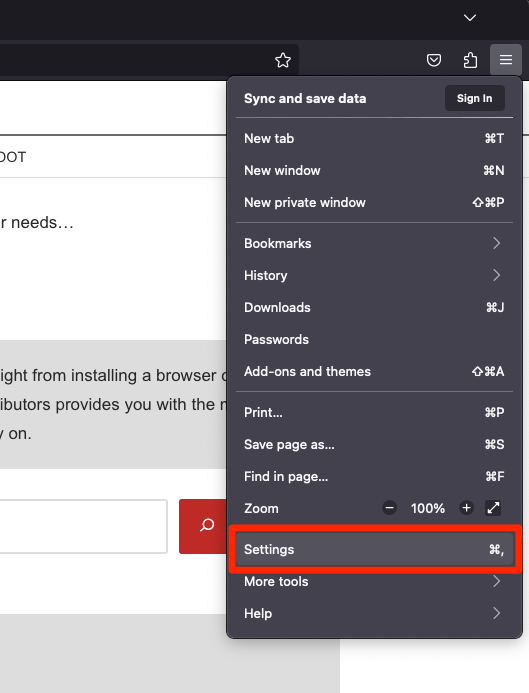
- Switch to the Privacy & Security tab and scroll to the Cookies and Site data section.
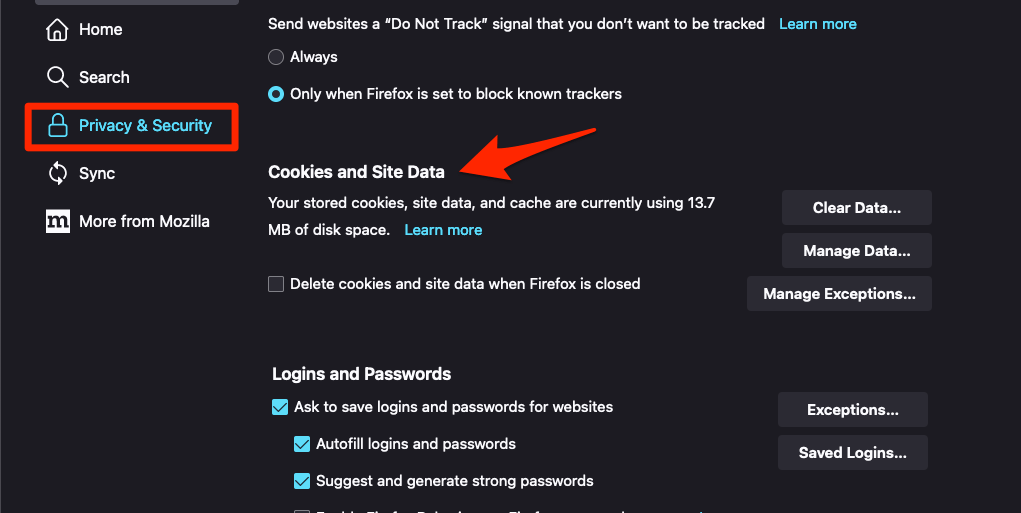
- Click on the button.
- Enable the checkbox for the 'Cookies and Site Data' and 'Cached Web Content' options.
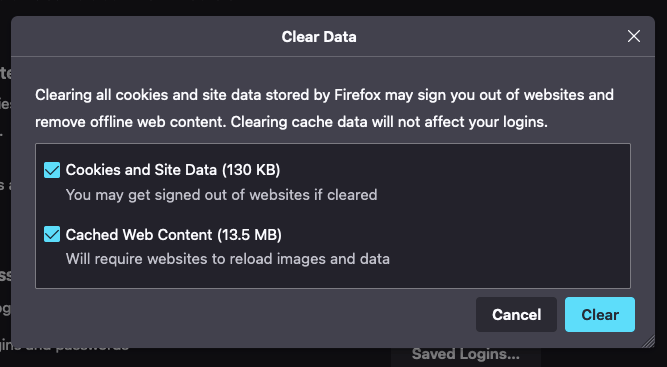
- Hit on the option.
It will immediately delete the cache, cookies, and site data on the browser.

TIP: If you only need to remove a single site’s cookies, use Manage Data from the same section and select that site instead of clearing everything. That avoids signing out of every other site.
Sign in to the affected site again. You’ll know it worked when the site accepts the new cookie and no longer drops your login after a restart. For a more detailed walkthrough of the same dialog, see the clear cookies and cache guide for Firefox.
Test in a Private Window and Try Troubleshoot Mode
A Private Window uses your current settings but starts with no cookies, no extensions, and a fresh cache. If cookies work there but not in a regular window, an extension or a leftover from your profile is almost always the cause.
- Press + + (or + + on macOS) to open a Private Window.
- Visit the site that was not accepting cookies.
- If it works here, return to the normal window and run Troubleshoot Mode to disable extensions temporarily.
- Click the hamburger menu at the top right of Firefox.
- Click Help.
- Select Troubleshoot Mode….
- Click Restart in the confirmation dialog.
With extensions disabled, test the site. You’ll know it worked when cookies persist with extensions off. Then re-enable your extensions one at a time to find the offender. The same diagnosis path is recommended in the Firefox history and profile maintenance guide for browser-wide behavior issues.
Refresh Firefox as a Last Resort
If cookies still refuse to behave after all of the above, Refresh creates a fresh profile while keeping your bookmarks, passwords, and browsing history. It is the most thorough reset short of a full reinstall, and it can clear a corrupted profile that silently breaks the storage layer.
- Click the hamburger menu , choose , then select .
- On the Troubleshooting Information page, find the Give Firefox a Tune Up section on the right.
- Click Refresh Firefox and confirm by clicking in the dialog.
- Wait for Firefox to restart. Your bookmarks and logins are preserved, but extensions and most site settings are reset.
After the refresh, return to Settings, then Privacy & Security, then Cookies and Site Data, and re-enable any custom per-site exceptions you had set. Refresh resets those. Then test the site that was failing.
Frequently Asked Questions
Why is the Manage Data list empty in Firefox?
An empty Manage Data list simply means no website has stored a cookie for the current Firefox profile yet. It does not, by itself, mean cookies are blocked. Visit a site that uses cookies, reload, then reopen Manage Data, and the entry should appear.
Does Firefox block third-party cookies by default?
Under Standard Enhanced Tracking Protection, Firefox isolates third-party cookies in a per-site cookie jar, called Total Cookie Protection. They are still set, but they are not shared across different sites. To allow them everywhere, switch ETP to Custom and untick “Cookies”.
Will clearing cookies log me out of every site?
Yes. Clearing cookies and site data in Firefox signs you out of every site that relies on cookies to keep you signed in. Your saved logins in about:logins are kept, but each site will ask you to re-authenticate the next time you visit.
Are cookies and site data the same thing?
Firefox groups HTTP cookies with related browser storage, including localStorage, sessionStorage, IndexedDB, and service worker caches, under the label “Cookies and Site Data”. When you turn that option on or off, you are controlling all of them at once.
Where do I find Mozilla’s official documentation for cookies?
Mozilla’s reference for these settings lives at the Cookies – Information that websites store on your computer support article, which mirrors the options described above and is updated with each Firefox release.