Firefox can stop offering to save logins, or refuse to fill credentials you know are saved, for a handful of reasons. The usual culprit is a site sitting in the Exceptions list after you clicked Never Save, but the global save and autofill toggles under Privacy and Security can also be off.
We'll walk through each cause in the order it most often appears: the Exceptions list, the Ask to save and Autofill toggles, and the Primary Password setting that keeps saved logins locked until you authenticate.
In this guide, I have covered:
Contents
Why Firefox rejects saved passwords on websites
You type a username, expect Firefox to fill the password, and nothing shows up. Sometimes Firefox will not even offer to save a new login. Both failures look like Firefox rejecting a saved password, but they usually come from one setting that blocks the site or disables autofill.
The most common trigger is the Exceptions list. Every time you pick Never Save from the prompt, Firefox adds that domain to a quiet blocklist. Once a site is listed, Firefox will not save or fill a password there, even if a working login already exists in about:logins.
Other causes include a turned-off global toggle, a locked Primary Password, or a security add-on that blocks autofill before Firefox can act.
Check the Exceptions (Never Save) list first
If Firefox fills passwords on other sites but not this one, start here. We usually check this list first because it is the quietest cause and the fastest fix.
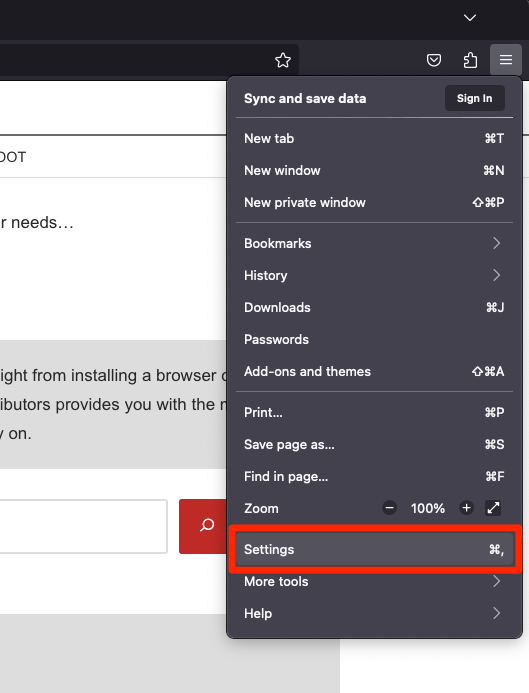
- Open the hamburger menu
 and choose Settings.
 - Click Privacy & Security in the left sidebar.
- Scroll to the Logins and Passwords section.
- Click Exceptions to see the full list of skipped sites.
- Search the list for the site whose password seems to be missing.
- Select the entry and click Remove Website to allow Firefox to save logins for it again.
You’ll know it worked when Firefox fills the saved password immediately after you reload the site, or asks to save a new login on your next sign-in.

Choosing Never Save in the save prompt is a quiet action. Firefox adds the current domain to the Exceptions list without confirmation, which is why autofill can stop even though the saved login still exists in about:logins.
Make sure Firefox is allowed to save new logins
If Firefox is not prompting to save passwords on any site, the save prompt toggle is likely off. Turn it back on and the prompt should appear after your next sign-in.
- Open the hamburger menu in Firefox and click Settings.
- Select Privacy & Security from the left sidebar.
- Scroll down to the Logins and Passwords section.
- Tick the box next to Ask to save logins and passwords for websites.
With the box ticked, sign in to a site once and the save prompt should appear at the top of the window. If you want Firefox to never prompt on a single site again, choose Never Save from the prompt, and Firefox will move that domain to the Exceptions list.
Turn Autofill logins and passwords back on
If saved passwords appear in about:logins but never fill a form, this switch is usually the reason. Autofill is separate from the save prompt.
- Stay in Settings → Privacy & Security → Logins and Passwords.
- Tick the box next to Autofill logins and passwords.
- Reload any tab where the form was not auto-filled.
You’ll know it worked when Firefox drops the saved username and password into the form without a click. For every toggle in this section, see the Add, Edit, and Manage Passwords in Firefox guide. The same menu also has Suggested and generated passwords, which controls whether Firefox offers to generate a new password on a sign-up form.
Unlock saved logins with the Primary Password
A Primary Password locks the whole vault behind one master credential. A grey padlock icon in the password manager toolbar entry means the vault is locked. Until you enter it once per session, Firefox will not fill any saved login.
- Click the eye icon next to the Password field on about:logins.
- Look for a system popup from Windows Security, macOS Keychain, or your Linux authentication agent.
- Enter your Windows account password, scan your fingerprint, or approve the Touch ID prompt.
- Return to Firefox. The password should now be visible in the field.
You’ll know it worked when Firefox starts filling saved credentials after you authenticate.
If you have forgotten the Primary Password, reset it through Mozilla’s Primary Password guide.

ALERT: The reset removes every saved login in this profile. Back up any credentials you need before you reset.
Open the Saved Logins page to verify the entry is correct
If the exception and toggles are fine, confirm the stored entry is correct. The Saved Logins page shows exactly what Firefox has for each site.
- Click the hamburger menu at the top right of Firefox.
- Choose Passwords from the menu. Firefox opens about:logins in a new tab.
- Alternatively, type about:logins into the address bar and press to jump straight to the list.

TIP: Type about:logins in the address bar to open the same page without clicking through Settings.
If the saved entry has the wrong username, password, or hostname, click the row and use the pencil icon to edit it. You’ll know it worked when Firefox fills the corrected entry on your next visit to the site.
Reveal the saved password to confirm it matches the site
When a saved login exists but the password still fails, show the stored value and compare it with the one the site expects.
- Click any saved login in the left column to open its details on the right.
- Click the eye icon next to the Password field.
- If a confirmation popup appears, click Allow to display the password.
- Read or copy the value, then click the eye icon again to hide it.
If the revealed value does not match the password you actually use, edit the entry. Many reports of Firefox rejecting a saved password trace back to an outdated credential saved years ago, after the password was rotated elsewhere.
Clear the site’s cookies and cache
Stale cookies for the target site can hold a session that conflicts with autofill. This happens often on sites that changed their login form structure.
- Open the Firefox browser on your computer.
- Click on the More menu and select the Settings menu.
- Switch to the Privacy & Security tab and scroll to the Cookies and Site data section.
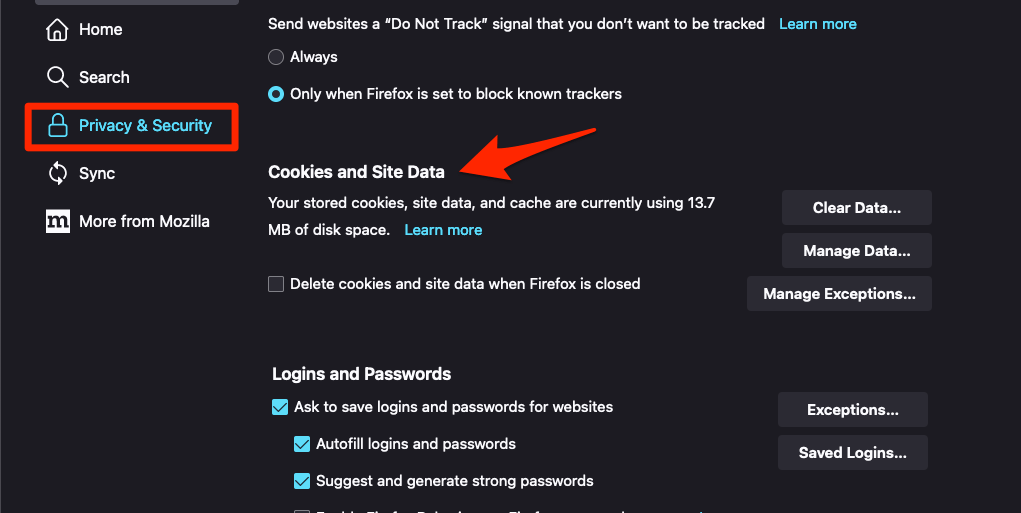
- Click on the button.
- Enable the checkbox for the 'Cookies and Site Data' and 'Cached Web Content' options.
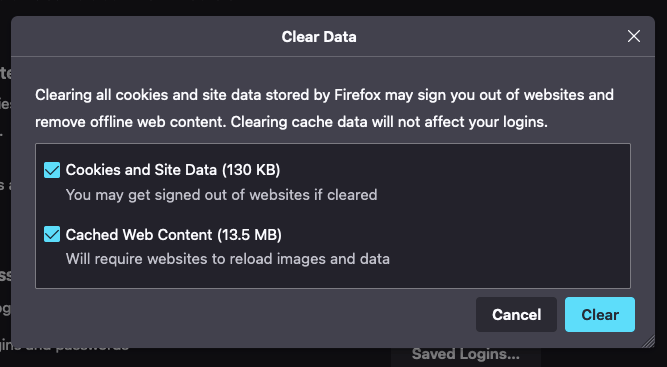
- Hit on the option.
It will immediately delete the cache, cookies, and site data on the browser.
You’ll know it worked when the site accepts the saved login after a fresh reload. If cookie controls are greyed out under Enhanced Tracking Protection, see the site settings guide for Firefox on the Computer to whitelist the site first.
Check for extensions or security software blocking autofill
Password manager extensions, privacy add-ons, and antivirus tools can grab form submissions before Firefox gets a chance. If autofill stopped after you installed something, this is a good place to test.
- Click the hamburger menu and select .
- In the left sidebar, click .
- Use the blue toggle next to each extension to disable it. Start with ad blockers, tab managers, and any extension you installed in the past few weeks.
- Restart Firefox from the hamburger menu .
- Use Firefox normally for a few minutes, then check about:performance. If usage dropped sharply, re-enable extensions one by one to find the offender.
If a search hijacker or toolbar appeared around the same time, remove it too. Our search.conduit.com malware removal guide shows how to clean that infection from Firefox.
Outside the browser, security suites from vendors like ESET, AVG, and Kaspersky have shipped features that block Firefox from accessing its own credential store. If you use one, look for an Application Control or Browser Privacy option and add Firefox to its allowlist.

Frequently Asked Questions
Why does Firefox not offer to save a new password on a single site?
The site is most likely in the Exceptions list. Open about:logins, click the gear  to reach Exceptions, select the entry, and click Remove Website. Firefox will start offering to save logins for that domain on your next visit.
Firefox is not filling my password on a site that is not in Exceptions. What now?
Check Ask to save logins and passwords, then Autofill logins and passwords, then the Primary Password toggle. Stale cookies for the site can also stop autofill, so clear them as a follow-up. If the problem still persists, run Firefox in Troubleshoot Mode to rule out extensions.
Is there a difference between Ask to save and Autofill?
Yes. Ask to save controls the prompt that appears after you sign in for the first time. Autofill controls whether Firefox fills saved credentials into existing forms. Turning either one off looks like a rejection from your side.
Will removing a site from Exceptions also remove its saved login?
No. The Exceptions list only blocks Firefox from saving and filling on that site. The stored credential stays in about:logins and becomes available to autofill again the moment you remove the exception.
Does Firefox Sync reset these settings on my phone?
Sync can carry saved login entries to Firefox on Android and iOS, but the Logins and Passwords toggles and the Exceptions list are configured per device. You will need to repeat the relevant steps in Settings → Privacy and Security on mobile Firefox if it shows the same behavior.