Free Chrome VPN extensions can hide your IP address and open region-limited sites, though many cap your data, slow your speed, or route traffic through other people's devices. The trade-offs matter more than the label.
Pick by free allowance, peer-network risk, and whether the extension still runs on current Chrome. Check the publisher and permissions before you connect.
In this guide, I have covered:
Contents
What a Free Chrome VPN Extension Can and Can’t Do

Editor’s Note: This ranking weighs privacy protection, free-plan value, ease of use, and fit with Chrome. Free VPN offers change, so confirm the current terms before you install one.
A free Chrome VPN extension changes the IP address websites see, but only for traffic that runs through Chrome. That is enough to reach a region-limited page and to keep your approximate location out of casual view on public Wi-Fi.
Scope is the catch. Most of these extensions work as browser proxies: they do not encrypt other apps, and they do not protect every device on your network. Some ask for an account, cap monthly data, or route you through other people’s machines.
The ranking below weighs privacy, what the free tier actually gives you, and day-to-day reliability in Chrome.
Free VPN Extensions for Chrome at a Glance
The table separates what you get for free from the catch that shows up in daily use.
| Extension | What is free | Main catch | Best for |
|---|---|---|---|
| Proton VPN | Unlimited data and no ads | Limited free server locations | Privacy-first everyday browsing |
| Windscribe | 10 GB per month | Limited data and locations | Ad and tracker blocking |
| Hotspot Shield | Unlimited data on the desktop free tier | Ad-supported free experience | Unlimited browsing data |
| CyberGhost | Free extension and account | Some features require payment | Users considering an upgrade |
| VeePN | Unlimited data and server switching | Heavier extension and variable speed | Protocol and leak-protection options |
| ExpressVPN | Free-to-install extension | Not a full free VPN tier | Users willing to upgrade |
| Hola | Free peer-network access | User devices can act as relays | Casual, non-sensitive use |
1. Proton VPN: Best Free Option for Privacy-First Browsing
Most people hunting for a free VPN want two things: no data cap and a provider that takes privacy seriously. Proton VPN covers both. Its Chrome extension now comes with the Proton Free plan, not only with a paid subscription or trial.
The free tier limits server choice, but it does not limit how much you use. That makes Proton practical for everyday browsing, research sessions, and sites that check which country you are in.
If Chrome is mainly a study tool for you, our list of 6+ Best Google Chrome Extensions for Students covers the rest of the setup.
What Proton Free includes
- Unlimited data and no ads on the free service
- A stated no-logs policy under Swiss jurisdiction
- Secure Core network and AES-256 encryption
- Chrome extension included with the free account
Expect fewer locations on the free tier, and expect that list to shift as Proton adjusts its network. Broader streaming access and extra features sit behind a paid subscription.
2. Windscribe: Best for Ad Blocking With a Free Data Allowance
You want ad blocking without paying twice for it. Windscribe pairs a 10 GB monthly allowance with built-in blocking, and its Chrome extension masks your IP address for browser traffic. Free users get a shorter list of locations than paying customers.
If blocking ads is the main goal, the 10+ Best Ad Block Extensions for Google Chrome will do that job better than a VPN will.
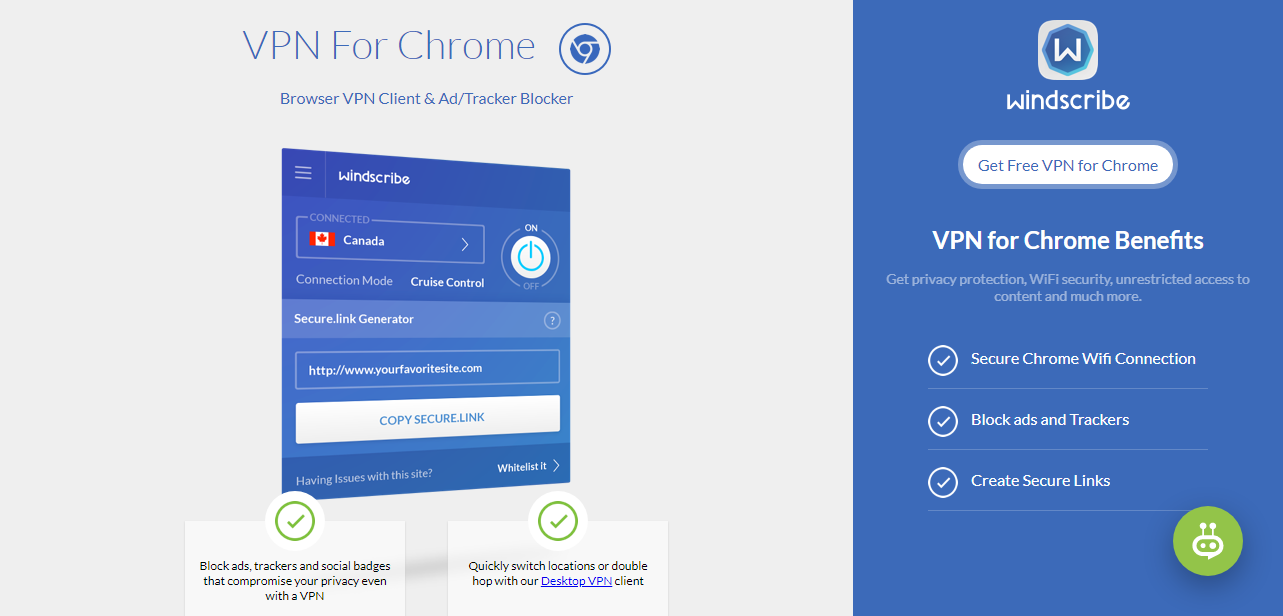
What the extension offers
- 10 GB of data each month on the free plan
- Built-in ad and tracker blocking
- OpenVPN, IKEv2, TCP, UDP, and SOCKS5 protocol options
- AES-256 encryption, Stealth mode, and split tunneling
Two limits matter: 10 GB a month and the number of free locations. Speed depends on the nearest free server and its current load, so try a download before you rely on it.
3. Hotspot Shield: Best for Unlimited Desktop Data
Hotspot Shield’s advantage is simple: no data counter on the current desktop free tier. The old 500 MB daily cap no longer describes the Chrome offer.
It uses the proprietary Hydra protocol and combines IP, DNS, and WebRTC leak protection with tracker blocking. The interface is easy to read. Real speed still depends on the server you land on.
Hotspot Shield highlights
- Unlimited data on the current desktop free tier
- Hydra protocol for fast connections
- IP, DNS, and WebRTC leak protection
- AES-256 encryption and tracker blocking
- Streaming and other advanced tools reserved for paid plans
Expect ads and different privacy terms on the free tier. Read the current privacy policy before you use it for sensitive work or banking.
4. CyberGhost: A Strong Choice With an Upgrade Path
CyberGhost suits anyone who plans to start free and upgrade later rather than switch providers. Location switching is quick, the server network is large, and the extension hides your browser IP address on public Wi-Fi. Streaming access is one of the main reasons to upgrade.
CyberGhost advertises a no-logs policy, a kill switch, and 256-bit encryption. Free allowances and server access can change, so do not assume the extension matches the paid catalog or its bandwidth.
CyberGhost highlights
- Large global server network
- Advertised no-logs policy
- Kill switch and 256-bit encryption
- Dedicated streaming servers, mainly for paid subscribers
- Cross-platform apps and a Chrome extension
Treat the free tier as a limited introduction to the service. If unrestricted streaming or one specific country is what you need, compare the current paid plan before you sign in.
5. VeePN: Unlimited Data With Broad Protocol Support
Unlimited data is the headline here. VeePN’s free service advertises unlimited bandwidth and server switching, plus DNS leak prevention and a kill switch.
It runs on OpenVPN and IKEv2 with 256-bit encryption. The extension is heavier than a light browser proxy, and speed drops when the selected server is busy or far away.
VeePN highlights
- Unlimited free data and server switching
- DNS leak prevention
- OpenVPN and IKEv2
- 256-bit encryption
- Kill switch and automatic configuration
Server load and distance still decide your speed. If Chrome feels sluggish with VeePN on, switch to a nearer server and turn off extensions you do not need running at the same time.
6. ExpressVPN: A Polished Browser Proxy With Paid Features
ExpressVPN is the pick when you want location controls, split tunneling, and leak protection in something that feels finished. The current extension uses Chrome’s own proxy controls, so it no longer needs the desktop app that earlier setups required.
Free to install is not the same as free servers. An account is required, and the widest location list plus some features stay behind paid membership.
ExpressVPN extension highlights
- WebRTC and DNS leak protection
- Network Lock kill switch
- Location spoofing
- AES-256 encryption with RSA-4096 and SHA-512 authentication
- Split tunneling
Treat this as a free-to-install extension rather than a free VPN tier. Proton and Windscribe give you clearer free allowances when cost is the deciding factor.
7. Hola: Free Peer Networking With the Largest Privacy Trade-Off
Hola is the one to skip for anything sensitive. Its free tier keeps costs down by routing some traffic through other users’ devices, which makes the service free and creates a bigger privacy trade-off than a standard VPN network.
Hola free-plan highlights
- Country selection for changing the apparent location
- Peer-network routing on the free plan
- Identity masking and split tunneling
You get fewer leak protections than a paid service, and some sites work poorly through a peer relay. Hola’s free mode has also drawn scrutiny over logging and encryption practices, so keep it away from banking, work accounts, and sensitive traffic.
Install a Free VPN Extension in Chrome Without Guessing
Install from the official Chrome Web Store listing, not a random download page. That listing is where you check the publisher and permissions, and whether the extension is still maintained, before Chrome hands over proxy access.
- Open the Chrome Web Store.
- Search for the exact provider name.
- Open the listing from the provider’s expected publisher.
- Review Site access and the requested permissions, including proxy access and access to website data.
- Click .
- Click in the confirmation prompt.
- Open Chrome’s extensions
 menu.
- Pin the VPN extension for quick access.
- Open the extension icon.
- If an account is required, create one or sign in.
- Select the free plan.
- Choose the available server or location.
- Click .
- Reload any page that was already open.
You’ll know it worked when the extension shows it is connected and names the country or server you picked. If it does not, reopen the extension and check the account status and site permissions.
Check That the Extension Is Routing Chrome Traffic
An icon in the toolbar proves nothing on its own. Compare your public address and approximate location before and after you connect.
- Open an IP address lookup page before connecting the extension.
- Note the public address and approximate location shown.
- Connect the extension to a server.
- Reload the lookup page.
- Confirm that the public address and approximate location have changed.
- Disconnect the extension.
- Reload the lookup page again.
- Confirm that the original address and location return.
You’ll know it worked when the public IP changes while connected and returns to your original address after you disconnect. If the address never changes, confirm the extension is connected, the account is active, and proxy permission is granted.
Free Extension Permissions and Privacy Checks
Free does not mean safe by default. An extension that can control your browser traffic deserves a look at these points before you use it daily:
- Publisher: Confirm the Web Store name and developer match the official VPN provider.
- Privacy policy: Look for clear detail on browsing data, advertising partners, and affiliate links.
- Site access: Chrome lists On click, On specific sites, and On all sites. A proxy may need broad access. Grant it only after you check the publisher.
- Free limits: Check the data allowance, available locations, speed restrictions, ads, and streaming access before installing.
- Account requirement: A free extension can still ask for a paid account to run its main service.
- Leak handling: Look for DNS and WebRTC protection and a kill switch, then test the extension instead of assuming it works.

TIP: A free extension covers Chrome only. It is not a replacement for a password manager, updated system software, or a full-device VPN app when you need that layer.
Why an Older Free VPN Extension May Not Install
You click Add to Chrome on an old listing and Chrome refuses, or the page says the extension has been turned off. That usually has nothing to do with your browser install.
Chrome has phased out Manifest V2, the older extension platform, in favor of Manifest V3. When a free VPN listing is disabled or marked unavailable, the provider has not moved it to the current platform.
The old chrome.google.com/webstore address still redirects to chromewebstore.google.com, so a working link is not proof that the extension is maintained. Check the listing date, publisher, and permissions, and do not sideload an old CRX file from an unknown site.
Which Free VPN Extension Should You Install?
Start with what you actually need: data, privacy, or a route to a paid plan later.
Proton VPN is the strongest all-round free pick when unlimited data, no ads, and a privacy-focused provider matter most. Windscribe fits if 10 GB a month and built-in ad blocking are enough.
Hotspot Shield suits anyone who wants unlimited desktop data, while VeePN adds broad protocol support to an unlimited free tier. CyberGhost and ExpressVPN make more sense if you expect to upgrade, because their strongest features sit behind paid plans. Hola is the weakest choice for anything sensitive since its free tier depends on peer relays.

Frequently Asked Questions
What is the best free VPN extension for Chrome?
Proton VPN is the best all-round fit for most readers. Its Chrome extension is included with the free plan, offers unlimited data, and has no ads. Free server selection is limited, and no free service should be trusted without checking its privacy terms.
Are free Chrome VPN extensions safe to use?
Safety depends on the provider and the permissions you grant. Check the publisher, privacy policy, account requirement, data limits, and site access before installing an extension that can control browser traffic.
Does a Chrome VPN extension protect my whole device?
No. These extensions route traffic handled by Chrome through a proxy. Other apps, DNS requests outside Chrome, and devices on your network may not get the same protection.
Why will my old VPN extension no longer install in Chrome?
Chrome has phased out Manifest V2 extensions, so old listings may be disabled even if they once worked. Choose a maintained extension or a current desktop VPN app rather than sideloading an old copy.
How much data does Windscribe give me for free?
Windscribe’s free plan includes 10 GB of data per month. The allowance resets each month, but heavy streaming and downloads can use it up quickly.