

Chrome on Android stores cached images, scripts, and service workers for each site you visit. The Data stored screen in Site settings shows how much space each entry uses and lets you wipe one site or all of them.
Clearing site storage does not remove passwords, bookmarks, or browsing history. If you want cookies gone too, use Delete browsing data under Privacy and security.
In this guide, I have covered:
Contents
View Site Storage Data in Chrome on Android
If Chrome on Android is using more space than you expect, the Data stored screen shows exactly which sites are responsible. Every site you visit can save cached images, JavaScript, CSS, and service worker files that help pages load faster next time. That same screen also gives you a one-tap way to remove stored data from individual sites or from all of them at once.
Open it like this:
- Open the Chrome app on your Android phone.
- Tap the More
 menu in the top-right corner and choose Settings.
 - Scroll down to the Advanced section and tap Site settings.
- Tap Data stored.
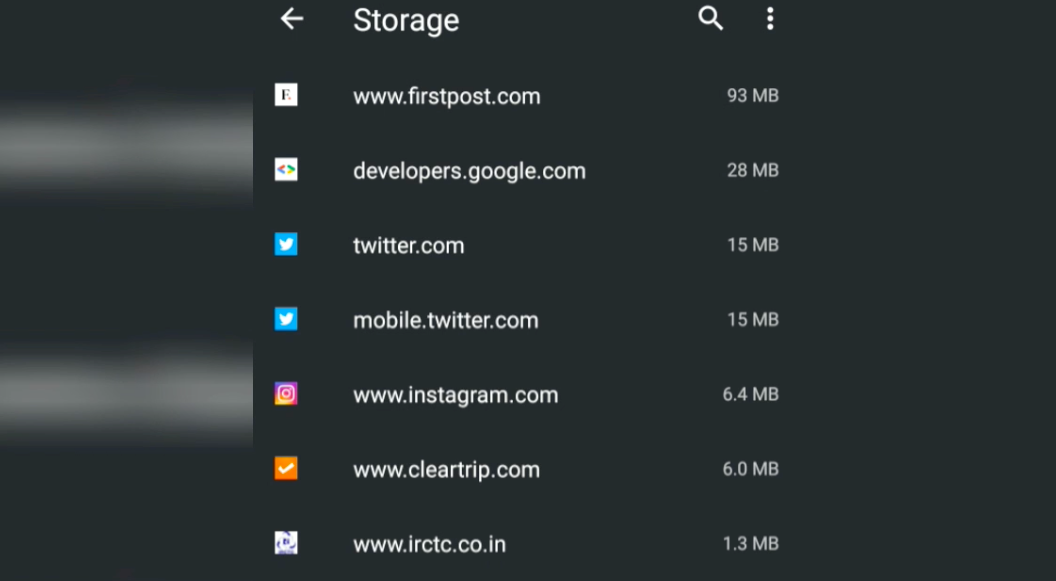
Entries appear in descending order by storage use. The site at the top is using the most space. Tap any entry to open a Usage page for that site, where you can delete just that site’s stored data.
Clear Site Storage for All Sites in Chrome on Android
When Chrome feels sluggish or your phone is low on space, clearing site storage is a safe first step. It removes cached files, local storage, and service workers. Your bookmarks, passwords, and browsing history stay untouched, and cookies are handled separately.

Clearing site storage does not delete cookies, so your sign-ins stay active. If you need cookies gone too, open Privacy and security and choose Delete browsing data, or follow our Clear Browsing and Site Data in Chrome on Android guide.
- Open the Chrome app on your Android phone.
- Tap the More menu and choose Settings.
- Scroll down to the Advanced section and tap Site settings.
- Tap Data stored.
- Scroll to the bottom of the list and tap Clear all data.
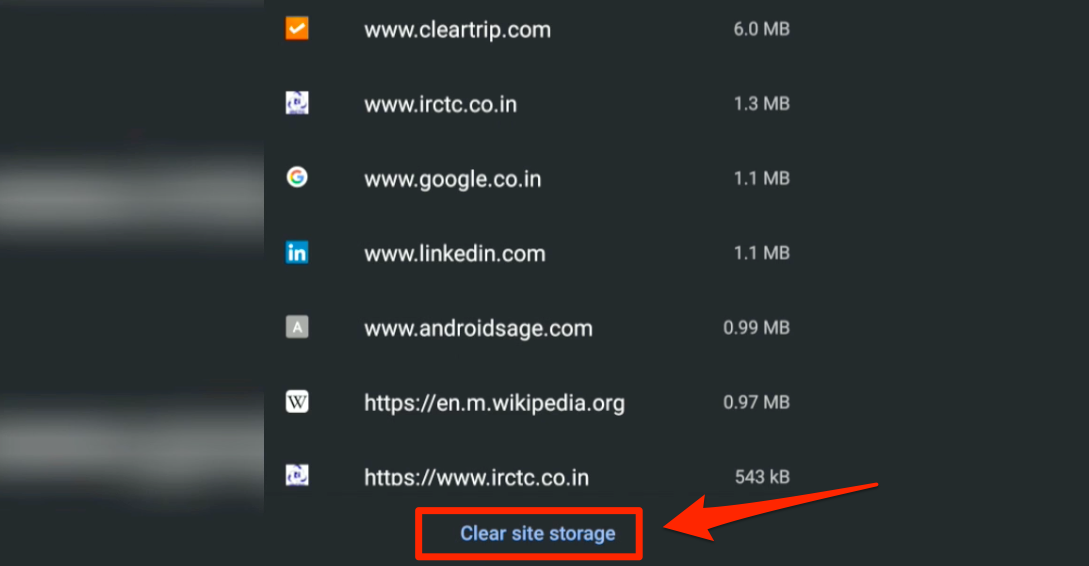
- Tap Clear on the confirmation prompt.
You’ll know it worked when the Data stored list shows no entries or 0 B for every site. Chrome wipes cached files and local storage for every site on the list, then rebuilds the data as you revisit each site.
Clear Site Storage for a Single Site
If only one site is misbehaving, wipe that site’s storage instead of resetting everything. This keeps your other sign-ins and cached pages intact.
- Open the Chrome app on your Android phone.
- Tap the More menu and choose Settings.
- Scroll down to the Advanced section and tap Site settings.
- Tap Data stored.
- Tap the site URL you want to remove.
- Under Usage, tap the trash icon.
- Tap Clear all on the confirmation prompt.
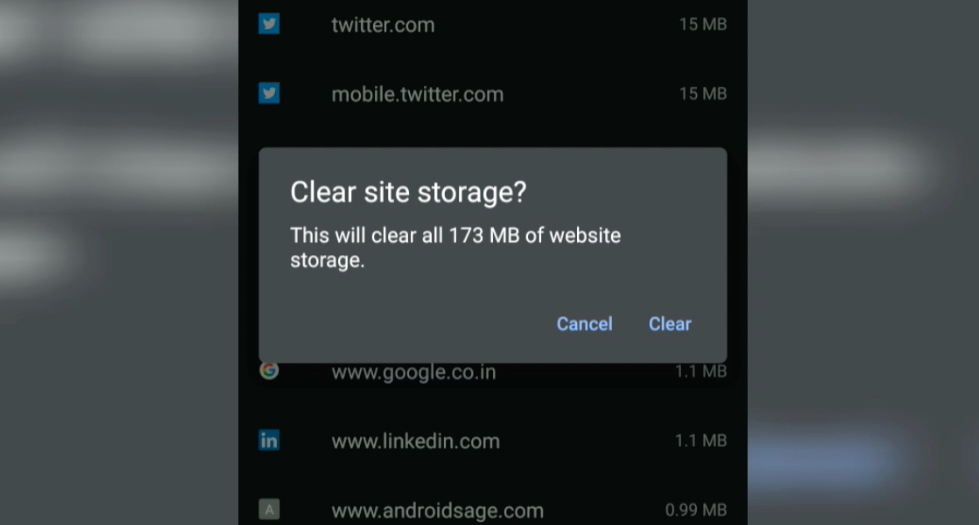
Chrome deletes only the cached files for that site. The next visit pulls a fresh copy from the web. You stay signed in everywhere else.
About the New “On-Device Site Data” Setting
If you would rather decide when Chrome saves local data at all, open the On-device site data menu in Site settings. It sits alongside Data stored and controls whether Chrome stores any new local data on your phone.
Choose Allow to let sites save data normally. Choose Delete on close to have Chrome wipe site storage every time you quit the app. Choose Don’t allow to refuse new local data when a site asks for it.
Google documents this toggle in its guide to on-device site data in Chrome.
Think of Data stored as the receipt and On-device site data as the rule. Use Data stored to inspect or wipe a site’s existing cache. Use On-device site data to change the policy that decides whether Chrome saves any new local data at all.
For a walkthrough of every category in Site settings, see our guide to viewing site settings and site information in Chrome on Android.

Bottom Line
Site storage in Chrome on Android shows which sites are using the most space on your phone. The Data stored screen gives you a per-site breakdown and a safe way to clear it. The On-device site data setting is the policy switch that decides whether Chrome saves new local data at all.
If you are cleaning up on a desktop browser too, open the same storage view in Chrome on your computer. The desktop version also has a separate Site information and settings panel.
Frequently Asked Questions
What is the difference between Data stored and On-device site data in Chrome on Android?
Data stored is the per-site breakdown that shows how much space each website has cached. You can delete one entry or every entry at once. On-device site data is a single policy switch with three options: Allow, Delete on close, and Don’t allow.
Will clearing site storage sign me out of websites?
Not by itself. Clear all data removes cached files and local storage, but leaves cookies alone, so your sign-ins stay active. To log yourself out everywhere, run Delete browsing data under Privacy and security instead.
Does clearing site storage free up space on my Android phone?
Yes. The Data stored list shows the byte count per site, and clearing entries reclaims that space inside Chrome’s app data. Your downloads, photos, and other apps are untouched.
Does clearing site storage delete saved passwords?
No. Saved passwords live in Google Password Manager, not in the Data stored list. Clearing site storage removes only cached files, local storage, and service workers that Chrome uses to speed up repeat visits.
Can I recover site storage after I delete it?
No. The deletion is permanent on the device, but Chrome rebuilds the cache the next time you load each site. Nothing breaks after a wipe.






The title of the article is a lie. It says that it explains how you can VIEW the site storage on Chrome Android. Seeing the size of the storage isn’t even close to viewing it. But “seeing the size” isn’t good for SEO, so a misleading title was chosen.
If I got a document viewer for Word and all it did was showing me the size of the file I would be royally pissed. And I doubt very much anybody else would see that differently.
does data stored in google chrome eventually disappear after so much time, or does in remain on the phone permanently?
If I never clear cache data will it eventually clear itself or stay on my phone as long as I own the phone?
I lost my phone now I can’t get into my Google account please help
Me
OK well I would like to be able to view the information stored stored not just see the size of the amount stored but the actual information….. Can you tell me how I can do that?
The data is stored in a machine-readable format. We cannot view or read the data stored.
Very helpful. Thank you
Like Alicia, I too don’t quite understand. I keep getting different info from my husband about why 1 site is larger than another one that I’d believe to be largest because it is used most. I’m told the size is only how big a file is…in the site??
Please answer this…Google is 4 sites down on the list under dating.com. I need 1 person to tell me honestly how it works. Because, as of right now it’s looking like I might need an attorney.
Thanks
First of all, apologies for creating confusion here.
Yes – your husband is correct. It highly depends on the file size of the site assets. Google.com is a very light site that doesn’t have many assets (images, gif, HTML, etc.) whereas dating’s homepage is filled with these assets. Hence, visit google’s ten times might be equivalent to one dating’s visit. I hope this clears.
About the websites data stored in site storage in Chrome, do you actually have to visit said site and look around or could it just be a pop-up that pops up a lot from the websites that the user frequents? What lands those websites into site storage and not others?
Hi Alicia, thanks for your question.
Basically, every website that loaded on the browser trying to store the data into browser storage. Irrespective of whether you’ve visited or loaded that site in the background as a pop-up.
From a technical standpoint, it also depends upon the website set up, whether the site administrator has configured with browser caching or not. If the browser cache is not enabled, then we will have zero storage from that site.
Hope this helps!