

A page opens in a language you don't read, and copying the text into another app gets old fast. Chrome on iPhone and iPad can translate the page in place, so you keep reading in the same tab.
Open the page, tap the More menu, and choose Translate. From the banner you can swap the target language, set a source language to translate automatically, or bring the original page back.
In this guide, I have covered:
Contents
Translate a webpage in Chrome on iPhone and iPad
A page opens in a language you can’t read, and copying the text into a translator app is more work than it’s worth. Chrome translates it in place. It detects the page language and uses Google Translate to show you a translated version.
- Open Google Chrome on your iPhone or iPad.
- Open the webpage you want to translate.
- Tap the
 menu, labeled More.
- Tap Translate.

Once translation finishes, a language banner appears at the top of the page. It shows the target language and gives you controls for changing the translation or returning to the original.
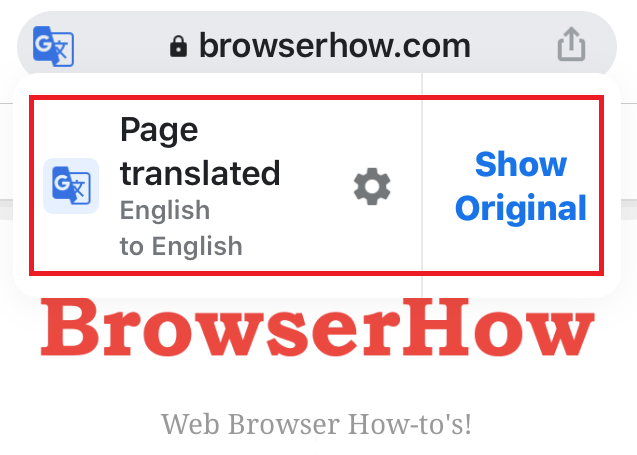
You’ll know it worked when the page text appears in your chosen language and the banner names it. Chrome may offer to translate on its own when it detects a foreign-language page. When that prompt doesn’t appear, the More menu holds the same command.
Watch the Video Tutorial
Watch the page translation walkthrough for Chrome on iPhone and iPad.
Change the language Chrome uses for a translated page
Chrome sometimes guesses wrong, and the translated page comes out in a language you still can’t read. Change the output from the banner at the top of the page. On iOS, that setting is tied to the language, not to a fixed Always translate English choice.
- Tap the language name at the top of the translated page.
- Tap the target language you want.
The page refreshes in the selected language. This choice applies to the current translation only. It does not turn on automatic translation for future pages.
Always translate a source language automatically
If you read the same foreign language every day, tapping Translate each time gets old. Chrome can apply the translation on its own, but only to the language named in the option. Every other language stays untouched.
- Open the foreign-language page in Chrome.
- Tap the menu.
- Tap Translate.
- Tap the language label at the top of the translation banner.
- Tap the settings gear
 in the translation controls.
- Tap Always translate [language].
The next page in that source language should open with the translation already applied.
Chrome’s mobile and desktop menus are different. For the desktop steps, see Translate a Webpage Text in Chrome on Computer.
Manage page translation in Chrome Settings
Sometimes the translate offer never shows up. Other times it shows up on pages you wanted to read as published. Both trace back to two separate controls, and the Languages screen is where you check them.
- Tap the menu.
- Tap Settings.
- Tap Languages.
- Turn on Translate Pages if it is off.
- Tap Add Language if the language you want is not listed.
The switch controls whether Chrome offers page translation across the app. The Always translate option stays tied to one source language, so check both when the behavior does not match your preference.

TIP: Turning off the global switch and turning off an Always translate rule are separate actions. Do one and the other setting stays exactly as it was.
Translate selected text instead of the full page
Sometimes one paragraph is all you need, and reflowing the entire page is not worth it. Highlight the passage and send it to Google Translate from the selection menu. The rest of the page stays in its original language.
- Touch and hold a word to start a text selection.
- Drag the selection handles to cover the text you want.
- Tap Google Translate in the selection menu.
Chrome shows the translation for the selected passage while the rest of the webpage stays unchanged. Selecting text works the same way as when you find a word on a page in Chrome on iPhone or iPad, so the drag handles should feel familiar.
Show the original page again
The translation looked promising, but the layout is broken or the wording is off. You can switch back without closing the tab or losing your place. The URL stays the same, so you can translate it again whenever you need to.
- Tap the language name at the top of the translated page.
- Tap Show original.
The page returns to its original language in the same tab.
Fix a missing or unwanted translation
Two things go wrong most often. Translate disappears from the menu, or Chrome translates a page you wanted to read as it was published. The global switch and the saved per-language rule control different parts of the feature, so check both.
When the Translate command is missing
If Translate no longer appears in the menu, start with the global switch.
- Tap the menu.
- Tap Settings.
- Tap Languages.
- Confirm Translate Pages is on.
If the switch is already on, an outdated Chrome installation may be the remaining issue. Update it from the App Store and check the menu again.
When Chrome translates a language automatically
A page changes language before you ask for it. That usually means an Always translate rule is still saved for that language.
- Open a page that Chrome has translated.
- Tap the language label at the top of the translation banner.
- Tap the settings gear in the translation controls.
- Turn off Always translate [language] for that source language.
Pages in that source language no longer change automatically.

Frequently Asked Questions
How do I translate a page in Chrome on iPhone and iPad?
The page translation command sits in Chrome’s More menu under Translate. After you tap it, Chrome shows the translated page and a language banner at the top.
Can I translate only selected text on iPhone or iPad?
Chrome can translate a highlighted passage through Google Translate in the text-selection menu. The rest of the page stays in its original language.
Why is the Translate option missing?
Check whether Translate Pages is on in Chrome’s Languages settings, then update Chrome if it is. Those two controls decide whether the browser can offer page translation at all.
How do I change or always translate a language?
The language name in the top banner sets the output language. The gear menu in that banner holds Always translate [language], which applies to the source language named in the option.
How do I show the original page after translation?
The Show original command in the translation banner restores the page text without closing the tab. Nothing is lost, and you can run the translation again from the More menu whenever you need it.

Strangely, translation of the Lisbon, Portugal, newspaper, Diário de Notícias (at dn.pt) isn’t available in iOS Chrome, though it is on Safari. Very puzzling to me, since there are other sites (usually Brazilian) that Google has no problem with.