

A page opens in a language you don't read, and you'd rather not paste paragraphs into another translator. Microsoft Edge has a built-in translate button in the address bar and can offer it automatically.
Click the translate icon, choose the language you want under Translate to, and hit Translate. From the same panel you can always translate one source language, translate only the text you select, or switch back to the original page.
In this guide, I have covered:
Contents
Translate a Webpage in Microsoft Edge on Your Computer
A page opens in a language you can’t read, and you need it in yours before you can do anything else. Microsoft Edge translates it in place, in the same tab. No copying text into another service.
The engine behind it is Microsoft Translator, formerly Bing Translator. It covers more than 100 languages, and you choose the output language before the translated page appears.
- Open the foreign-language webpage in Microsoft Edge.
- Click the translate icon at the right side of the address bar.
- Open the Translate to dropdown and choose the language you want to read.
- Click .
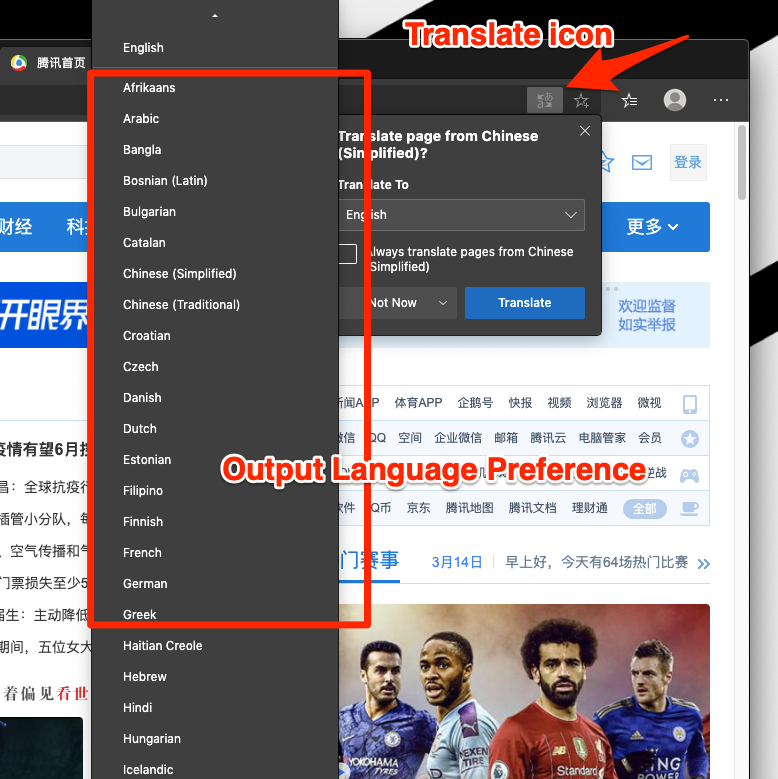
The page text switches to the language you picked. Edge also adds a control, so you can flip back and compare a sentence before you trust the wording.
Check Edge’s Automatic Translation Setting
Edge never offers to translate, no matter which page you open? The offer is enabled by default, so the setting was probably turned off at some point. Here is where to look.
- Open the
 menu, labeled Settings and more.
- Choose Settings.
- Select Languages.
- Under Preferred languages, select .
- Choose the language you read from the list.
- Drag the language to the top of the list if it is not already there.
- Confirm that Offer to translate pages that aren’t in a language I read is turned on.
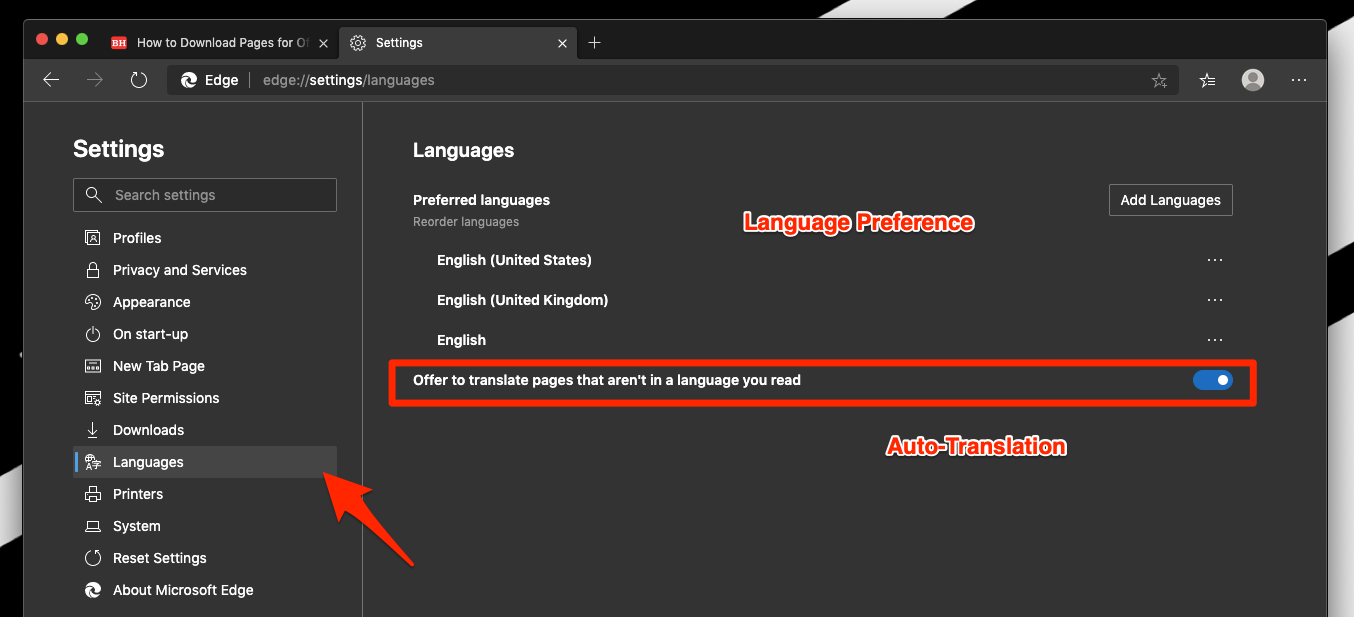
Close Settings and reload the foreign-language page. Edge should now show the translate icon in the address bar, or offer the translation on its own without you clicking anything first.
Automatically Translate Pages in One Language
Do you read the same source language every day? Set it once and stop clicking Translate on every visit.
- Open a page in the language Edge should always translate.
- Click the translate icon in the address bar.
- Open the Translate to dropdown and choose your output language.
- Check Always translate from [Language].
- Click .
Pages in that source language then open in your chosen output language, with no prompt in the way.

The always-translate choice is tied to the detected source language. Ticking it for Spanish does nothing for French pages, so repeat these steps for each language you read regularly.
Reading on a phone or tablet instead? You can use auto translate in Edge for Android. The controls sit in different places on a touch screen, but the same translation choices are there.
Translate Selected Text from the Right-Click Menu
Sometimes you need one phrase, one paragraph, or one table cell. Translating an entire page for that is overkill, so select just the text you need.
- Highlight the text you want to translate.
- Right-click the selection.
- Choose Translate selection.
- Choose the target language in the translation panel that Edge opens.
The rest of the webpage stays in its original language. That matters on a mixed-language page, or when you only need to confirm what a short passage says before quoting it.
Translate the whole page from the right-click menu
- Right-click an empty area on the webpage.
- Choose Translate to….
- Pick the target language from the translation menu.
Edge translates the full page. If that option does not appear in the menu, use the address-bar method described earlier.
Show the Original or Stop Translation Offers
Sometimes Edge guesses wrong. It translates a page you wanted untouched, or it keeps asking about a language you never read. Both are fixable from the translation panel.
Show the original page
- Click the translate icon in the address bar while the page is translated.
- Select .
The page returns to its original language without closing the tab.
Never translate a language
- Open a page in the language Edge should leave alone.
- Click the translate icon in the address bar.
- Choose Never translate [Language].
Edge stops offering to translate pages in that source language. Everything else keeps working as before.
Dismiss the current offer
- Open the translation prompt.
- Choose .
Not now hides the current offer only. The prompt comes back on the next page in that language, which is what you want when you are not ready to make the choice permanent.
Translate a PDF in Edge
Research papers, manuals, and reports often arrive as PDFs, and the PDF viewer uses its own toolbar. Edge can offer translation from there.
- Open the PDF in Microsoft Edge.
- Look for the translate icon in the PDF toolbar.
- Open the translate control.
- Choose your target language.
- Click .
The translated text appears in the PDF viewer, so you can read it without downloading the file or opening another app.
No translate control in the PDF toolbar? That means Edge is not offering its in-viewer translation option for this file.
Fix Edge Translation Problems
The translate button is missing, the wrong language comes out, or the translation vanishes after a reload. Find the symptom below and work through that check.
The translation prompt does not appear
- Open the menu, labeled Settings and more.
- Choose Settings.
- Select Languages.
- Confirm that Offer to translate pages that aren’t in a language I read is turned on.
- Close the Settings page.
- Reload the foreign-language webpage.
- Click the translate icon if it now appears.
Edge can offer translation only when that setting is enabled and it recognizes the page’s language. You’ll know it worked when the icon shows up on the next foreign-language page you open.
The output language is wrong
- Open the translate icon while the page is translated.
- Open the Translate to dropdown.
- Choose the correct output language.
Edge updates the page with the newly selected language.
The translation disappears after a reload
- Open the translate icon in the address bar.
- Check Always translate from [Language] if you want matching pages translated every time.
- Click .
If you do not want every page in that language translated automatically, repeat the manual translation after each reload. Edge treats it as a fresh visit each time.

Frequently Asked Questions
Does Microsoft Edge translate webpages automatically on a computer?
Edge offers to translate by default when it detects a page in a language you do not read. For a language you read often, choose Always translate from [Language] to translate matching pages without asking each time.
Which languages can Edge translate?
Edge uses Microsoft Translator, which supports more than 100 languages. The available output languages appear in the Translate to menu for the page you are viewing.
How do I change the output language?
Open the translate icon in the address bar, open the Translate to dropdown, and choose the language you want. Edge applies that choice to the page you are viewing.
Can I translate only selected text?
Yes. Select the text, right-click it, and choose Translate selection. The rest of the webpage remains unchanged.
How do I stop Edge from offering translation?
Choose Never translate [Language] to block one source language. To stop all translation offers, open Settings and more, choose Settings, select Languages, and turn off the translation offer.


how do you translate english pages into foreign languages? Not everyone reads and understands English well the first time. Ideally to a wide variety of Asian, African and South American languages.