Chrome keeps a cached copy of every page you visit, and sometimes that copy is what you see instead of the site's latest files. A hard refresh forces the browser to re-download the page's images, CSS, JavaScript, and fonts, and it leaves your cookies and logins alone.
Use the keyboard shortcut, the reload button, or DevTools, then clear the cache if the old page still wins.
In this guide, I have covered:
Contents
Watch the Shortcuts in Action
You want to see the refresh happen before you trust it on your own machine. The clip below runs through the same shortcuts on a desktop keyboard, so you can watch the page redraw.
What a Hard Refresh Does in Chrome
Your page is showing an old header, a broken image, or copy that should have changed ten minutes ago. A hard refresh tells Chrome to re-download the page’s files from the server instead of handing you the cached copy.
Images, CSS, JavaScript, and fonts get re-fetched, so the layout and any update the site just pushed appear on the spot.
What it leaves alone: cookies, site data, and saved logins. You stay signed in to Gmail, your bank, and every social network. If the old content survives a hard refresh, the cache or the cookies need clearing, not another refresh.
Hard Refresh With a Keyboard Shortcut
You’re at a laptop or desktop and want the page reloaded now, without hunting for buttons. The shortcut is the fastest route, and it works the same on every Chrome version for Windows, Linux, Chromebook, and macOS.
- Open the page you want to reload in Chrome.
- Hold on Windows, Linux, or Chromebook, or on macOS.
- Hold and press .
- Release the keys. Chrome re-fetches every file for the current tab.
+ on Windows and Linux, or + + on macOS, does the same job for anyone who reaches for F5 out of habit.
You’ll know it worked when the page redraws with new styling or a fresh timestamp. Phones and tablets have no equivalent shortcut, so the steps for a hard refresh in Chrome on iPhone and iPad are different.
Hard Refresh With the Reload Button
You’d rather keep a hand on the mouse. Pressing and holding the reload button does exactly what the keys do, and nothing else on the page changes.
- Launch Google Chrome on your computer.
- Open the website that needs a hard refresh.
- Press and hold on Windows or Linux, or on macOS.
- Click the Reload
 button on the address bar.
Hold and click the Reload button if another app has claimed the Ctrl-click combo. Either way, Chrome skips the cache for that single page load.
Empty Cache and Hard Reload From DevTools
You’re debugging a build, or Ctrl+Shift+R keeps handing you stale assets. DevTools has a third option that empties Chrome’s cache for every site before the reload even starts.
- Press (or + + on Windows and Linux, + + on macOS) to open DevTools.
- Keep DevTools open and click and hold the Reload button on the address bar.
- Choose Empty Cache and Hard Reload from the menu that appears.
This is the only built-in Chrome reload that empties the cache first. The other two methods bypass it for a single page and leave the old files in place.

DevTools has to stay open while you use that menu. Close it and the option won’t appear.
When to Clear the Cache Instead
A hard refresh fixes one page and leaves every cached file sitting in Chrome’s profile. The next site you open can go stale in exactly the same way. When the cache itself is the problem, clear browsing data from Chrome’s settings.
- Go to chrome://history/clearBrowserData in the address bar.
- Select the Time range from the drop-down.
- Enable the checkboxes for Browsing history, Cookies and other site data, and Cached images and files.
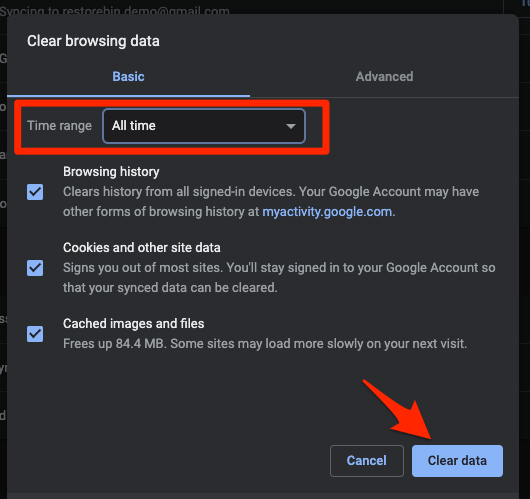
- Hit the Clear data button.

TIP: Skip the menu path. Type Delete browsing data in Chrome’s address bar and click the action chip. It opens the same dialog in one step. See Chrome’s actions shortcut help page for the full list.
For a narrower sweep, untick Browsing history and leave Cookies and other site data checked only when you also want to sign out everywhere. A cache-only wipe keeps Cached images and files selected on its own.
You’ll know it worked when the next page you open takes a beat longer to load. That first slow load is Chrome downloading the files again.
Hard Refresh Not Working as Expected?
The page keeps reloading by itself, or the refresh never seems to stick. That’s usually not a cache problem.
A misbehaving extension or a stuck tab can trigger reloads you never asked for, and no amount of cache bypassing will stop it. For that case, see our guide to stop auto reload of Chrome browser tabs.

Frequently Asked Questions
Does a hard refresh clear cookies in Chrome?
No. A hard refresh bypasses the cache and re-downloads files for the current page. Cookies, logins, and site data stay exactly as they were, so you remain signed in everywhere. To clear cookies, open the Delete browsing data dialog from the Chrome menu.
What is the difference between a hard refresh and clearing the cache?
A hard refresh skips the cache for one page load. Chrome fetches the latest files, but the old cache stays on disk. Clearing the cache deletes those stored files, so the next reload downloads everything from scratch and uses more bandwidth on that first load.
Why does my page still look old after a hard refresh?
A hard refresh only bypasses Chrome’s local cache. The site’s server or a downstream CDN may still be serving an older version, or your browser is reading stale cookies. Try Empty Cache and Hard Reload from DevTools, then clear cookies through the Delete browsing data dialog if the page still does not match the live site.
Is there a hard refresh shortcut on a Mac?
Yes. Press + + in Chrome on macOS, or hold and click the Reload button. Holding and clicking the Reload button works too.
Does a hard refresh log me out of websites?
No. Cookies hold your login state, and a hard refresh does not touch them. You stay signed in to Gmail, social networks, banking, and every other site you were already logged into.