Tapped a few links inside Safari and now you are three pages deep? The back and forward arrows get you out, and the screen-edge swipe plus a long-press shortcut save a lot of tapping.
Safari on iPhone and iPad gives you three ways to move between pages. Here is where each one lives after the iOS 26 tab bar redesign, and what to do when the swipe stops working in iPadOS 26 windowed apps.
In this guide, I have covered:
Contents
Go Backward to the Previous Page
You tapped a few links and now you want to get back to where you started. The back arrow in Safari’s toolbar is the fastest way out.
- Open the Safari app on your iPhone or iPad.
- Open any website and follow a few links to build up a back stack.
- Look for the left-pointing back
 button in the navigation bar.
- Tap it once to move back one page. Tap it again to keep walking back through the tab.

The back button stays active as long as the current tab has at least one earlier page. It greys out the moment you reach the first page you opened in that tab.
You’ll know it worked when the previous page slides in from the left and the forward arrow lights up beside the back button.
Go Forward to a Page You Came From
Tapped back one time too many? The forward button walks you up the same chain in reverse order.
- Use the back button to move at least one page back inside the current tab.
- Look for the right-pointing forward
 button sitting next to it.
- Tap once to step forward. Tap again to keep moving forward.
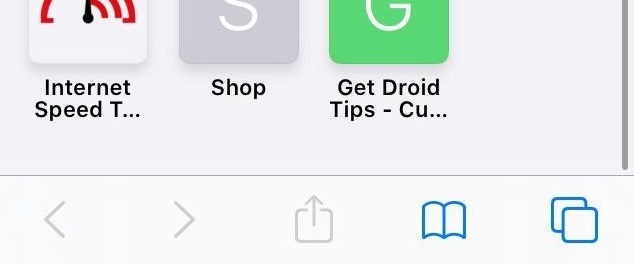
The forward button is greyed out whenever there is nothing ahead to return to. That happens either because you have already reached the newest page or because you have not moved back yet.
Swipe Right to Go Back and Left to Go Forward
Tapping buttons feels slow when you are flicking through pages. Safari’s screen-edge swipe works in portrait and landscape on both iPhone and iPad.
- Place your finger close to the left edge of the screen.
- Drag right until Safari starts sliding to the previous page, then lift your finger.
- To go forward instead, swipe from the right edge of the screen toward the left.

Apple added a system-wide “swipe back from anywhere on the screen” gesture in iOS 26, and it works in most native apps. Safari is one of the documented exceptions: the gesture does not move through tab history there, so keep using the edge swipe or the toolbar arrows.
Jump Straight to an Earlier Page from History
Sometimes you need to go back five pages, not one. Long-press the back button and Safari hands you the whole list at once. It also lists pages from other Safari tabs you have open on the same device.
- In Safari, long-press the back button in the toolbar.
- Review the list of pages in reverse order of when you opened them.
- Tap any entry and Safari jumps straight to it.
This beats tapping back a dozen times during a long research session. If you want to keep several threads open at once, you can also manage multiple tabs in Safari on iPhone or iPad.
Find the Back and Forward Arrows in the iOS 26 Tab Bar
Updated to iOS 26 and the back button seems to have vanished? It is still there, just in a different place.
Apple redesigned Safari’s tab bar in iOS 26. The new default Compact layout packs the navigation buttons into a slim row at the bottom of the screen, while Bottom and Top use a wider toolbar in the more familiar spots.
- Open the Settings app on your iPhone or iPad.
- Tap Safari, then tap Tabs.
- Pick Compact, Bottom, or Top.
- Return to Safari. The back and forward buttons now sit where that layout puts the navigation bar.
That setting is almost always the answer when the arrows seem to have disappeared after an update. Switching to Bottom or Top brings back the wider toolbar you may be used to.
Fix the Back Gesture That Stops Working on iPadOS 26
iPadOS 26 introduced Windowed Apps, which let you resize and move Safari around the screen like a desktop window. Windowed mode can intercept the left-edge swipe and make the back gesture feel broken.
- If a left-edge swipe does nothing, look at the corners of the Safari window for a small resize handle.
- Tap outside the window to exit windowed mode, or use the menu bar’s View > Go Back shortcut if you have a keyboard connected.
- When you cannot exit windowed mode, fall back to the toolbar back and forward buttons. They work reliably in every iPad layout.
The toolbar buttons behave the same in full-screen, Split View, Slide Over, and windowed modes. Reach for them whenever the swipe feels flaky.
Safari on the Mac uses the same two arrows and the same edge swipe. If you switch between devices, you can navigate forward and backward in Safari on Mac without relearning anything.

Frequently Asked Questions
Why is the forward arrow greyed out in Safari on iPhone?
The forward arrow only turns on after you tap back at least once. If you have not moved back, or you already reached the newest page in the tab, there is nothing ahead to step into. Tap back once and the forward arrow lights up.
How do I jump straight to the first page I opened in this tab?
Long-press the back button instead of tapping it. A list of every page in the current tab opens, oldest first. Tap the page you want and Safari jumps straight there.
Why does the swipe-to-go-back system gesture not work in Safari after updating to iOS 26?
Apple added the new “swipe from anywhere on the screen” gesture in iOS 26, and it works in most native apps. Safari is one of the documented exceptions for tab history. Keep using the left-edge swipe or the toolbar back button.
Where did the back button go after updating to iOS 26?
It did not disappear. iOS 26 changed the default Safari tab bar to a Compact layout that puts the back, forward, share, tabs, and menu buttons in a single slim row at the bottom of the screen. Open Settings > Safari > Tabs and choose Bottom or Top if you prefer the older wider toolbar.
Does private browsing change how back and forward navigation works?
No. Private tabs use the same toolbar buttons and the same edge swipes as regular tabs. The only difference is that the back history is dropped the moment you close the private tab.
Whichever layout or mode you are in, the toolbar arrows keep working. When a swipe or a gesture lets you down, tap the back arrow and carry on.