

Safari keeps a cache, cookies, and offline files for every site you visit. When pages get sluggish or your iPhone runs low on space, that hidden pile is often the reason, and Safari will show you exactly what each site is holding.
Open Website Data in Safari settings to see the per-site list, then delete one site's data or clear every site in a single pass. Neither route touches your saved passwords or your browsing history.
In this guide, I have covered:
Contents
View the Cache Safari Stores Per Site
Pages feel slow, storage is tight, and you want to know what Safari is actually keeping on your iPhone. It stores a cache, cookies, and offline data for every site you visit, and the full list sits a few taps away in Settings.
- Open the Settings app on your iPhone or iPad.
- Tap Apps, then Safari. On iOS 17 or earlier, Safari sits near the bottom of the main Settings list, so you can skip the Apps step.
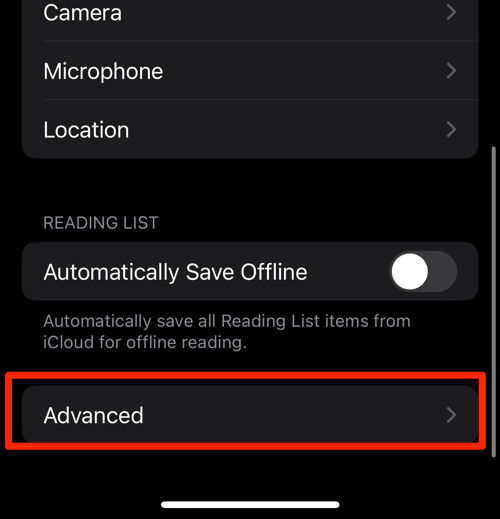
- Scroll to the bottom of the Safari screen and tap Advanced.
- Tap Website Data.
The list shows every site with data saved in Safari, with the storage amount to the right of each entry. Tap a site name and you get a finer breakdown of its cache, cookies, and local storage.

TIP: If you only want space back, scan those numbers on the right. A site you barely use that still holds a few hundred megabytes is the easiest win.
Delete the Site Data for One Site
One site keeps signing you out, shows a stale layout, or hangs on a blank screen after every refresh. Wiping that single site’s data is quicker than clearing everything and logging back in everywhere else.
- Open Settings, then Apps, then Safari.
- Tap Advanced, then tap Website Data.
- Tap Edit in the top right.
- Tap the red Delete icon next to the site you want gone, then confirm with Delete.
- Tap Done to leave the list.
That site’s cache and cookies are gone. Your next visit loads the page from scratch, and any session the cookie was holding now asks you to sign in again.
Clear All Site Data at Once
Safari feels bloated across the board, or you are handing the iPhone to someone else and want no site data left behind. A single pass clears every domain, which beats tapping through hundreds of entries one at a time.
- Launch the iPhone or iPad's Settings app.
- Select Safari in settings and scroll to the bottom to choose the Advanced option.
- Tap on the Website Data option.
It will display the list of all websites and corresponding data. - Tap on the command.
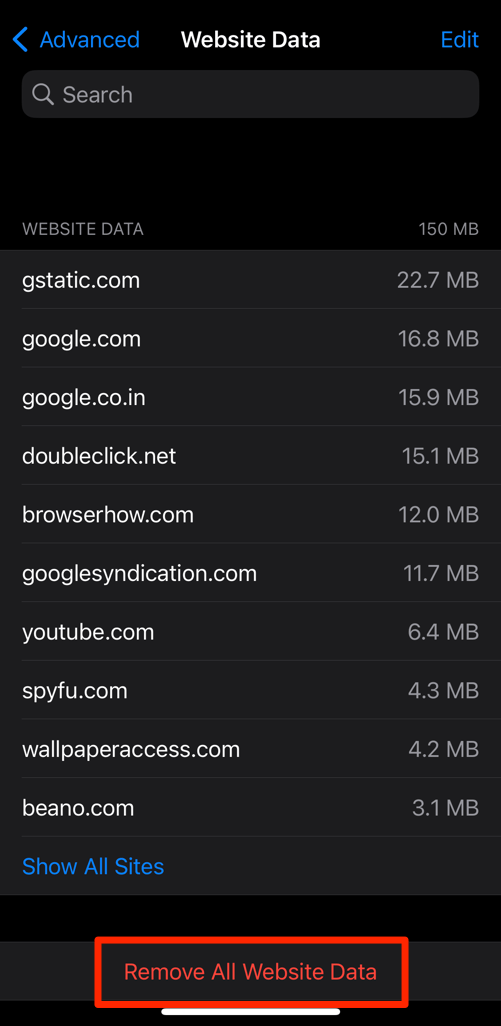 It will delete all the stored website data from the Safari browser.
You’ll know it worked when the Website Data list is empty, apart from any tab you have open at this moment. Expect a slower first load on your next visit, since Safari has to download those images and scripts again.
History stays put with this method. If you want that gone too, clearing Safari’s browsing data on iPhone and iPad handles cache, cookies, and history in one action.

Bottom Line
Caching exists for a reason: return visits load faster because the images and scripts already sit on your device. On a 64 GB or 128 GB iPhone, a few months of regular browsing can quietly claim several gigabytes of that space.
If the list shows a handful of heavy hitters you never visit any more, delete those one at a time. If the whole thing looks bloated, Remove All Website Data does it in one sweep.
Worth doing either way: disabling cross-site tracking in Safari cuts the cookie trail sites leave behind, so the list refills more slowly.
Frequently Asked Questions
A few things surprise people the first time they clear Safari’s stored data.
Does clearing Safari Website Data also delete browsing history?
No. Website Data and browsing history are stored separately. Clearing Website Data removes cache, cookies, and local storage only. To wipe history at the same time, use Clear History and Website Data on the main Safari settings screen.
Will clearing site storage sign me out of websites?
Yes, for any site whose cookie was holding your session. Saved passwords in iCloud Keychain stay untouched, so you never lose the ability to log in. You just type them in once on the next visit.
Where is the Safari cache stored on my iPhone?
Safari does not expose a cache folder the way a desktop browser does. Everything runs through Settings, then Apps, then Safari, then Advanced, then Website Data, the same screen you use to view and delete what each site holds.
Is the Safari cache the same as cookies?
No. Cache holds static files like images, scripts, and stylesheets so repeat visits load faster. Cookies hold small pieces of data that keep you signed in and remember your preferences. Website Data in Safari wipes both at once.
How much storage can Safari use for cached files?
There is no cap you can set yourself. Safari keeps caching while your iPhone or iPad has free space. iOS only steps in when the device is genuinely low on storage, and then it prunes old Safari data alongside everything else.





Where are the cache files physical stored? Many login data to subscribed web are stored in the cache and not in the password list on my Apple devices. I want to take a copy of selected ones to reuse them between the devices.
Hi Judit, it’s technically not possible to transfer the cache files between the devices. Even though you can copy them from one system to another, the new system (browser) may not be able to read them since it does not have a record of having a cache locally.
I downloaded Safari. I see the link referenced in the instructions but the link is not activated. What can I do to activate this link?
How do I view the files IN the cache? I am trying to recover a site that was corrupted by a virus and my cached version may be all that remains.
Hi Jennifer, we cannot view the files within the cache storage. The browsers stores the files in an unsupported format (we can say encrypted) that is not visible like a directory or folder structure. Alternatively, you can visit archive.org to view the older version of the web page (if available).