Cookies are what keep you signed in to your bank, your inbox, and your shopping carts. They're also how advertisers follow you from site to site, which is why Edge on Android gives you separate controls for each.
You can flip one switch for every site, block third-party cookies only, add per-site exceptions, and check how tracking prevention overrides all of it.
In this guide, I have covered:
Contents
Where to find cookie settings in Edge on Android
Every cookie control in Edge for Android sits behind the same menu path, whether you want a blanket rule or an exception for one site. Start here and you can find any of them in seconds.
- Launch the Edge app on your phone.
- Tap the
 menu at the bottom and choose Settings.
 - Tap Privacy and Security, then Site permissions.
- Tap Cookies to open the cookie controls.
That page holds the global toggle, the third-party switch, and both per-site lists.
Turn cookies on or off for all sites
Sometimes you just want cookies gone, everywhere, right now. The global toggle on the Cookies page is that switch, and flipping it back is just as quick.
- Stay on the Cookies page in Edge Settings.
- Tap the toggle labeled Allow sites to save and read cookie data (the wording varies on older builds).
- Toggle it Off to block all cookies, or back On to allow them.
Sites that need a login, like your bank or email, will stop recognizing you the moment you turn this off. Treat it as a temporary test, then turn it back on if your everyday sites break.
Block or allow third-party cookies
Third-party cookies come from advertisers and analytics scripts loaded by whatever site you’re visiting. Edge keeps them on a separate switch, so you can stay signed in while cutting most cross-site tracking.
- From the same Cookies page, scroll to Block third-party cookies.
- Toggle it On to stop most cross-site trackers, or Off to allow them.
Embedded videos, social share buttons, and shopping widgets are the usual casualties. If a checkout page or video player breaks, flip this switch off and reload.
Allow or block cookies for a specific site
One site needs cookies while the rest can go without, so you need an exception rather than a global rule. Edge keeps two separate lists: sites that can always use cookies, and sites that never can.
- On the Cookies page, scroll to Allowed to save cookies or Not allowed to save and read cookies.
- Tap Add site under the list you want to grow.
- Type the full site address, for example example.com, and confirm.
- Open the new entry to switch it between Allow and Block when you need to.
Reload the affected site so the new exception takes effect. To remove an entry later, open it and choose Remove.

TIP: Exceptions sit on top of the global rule, so you can block cookies everywhere and still allow the handful of sites you actually sign in to.

Check tracking prevention if cookies still won’t load
Cookies are on, yet the site still treats you like a stranger. Tracking prevention is the usual culprit. It’s a separate setting, and at Strict it strips third-party cookies even after you allowed them.
- Go back to Settings → Privacy and Security.
- Tap Tracking prevention.
- Pick Basic if a trusted site cannot keep you signed in or load embedded content.
- Pick Balanced for everyday browsing, or Strict for maximum blocking.
The same tracking prevention level applies to InPrivate tabs, so a private window will not help if Strict is breaking a site.
Clear cookies and cache when you want a fresh start
Saved cookies go stale, or they become the problem themselves. Clearing them signs you out of every site and drops any preferences stored in them.
- Open the Microsoft Edge app on your Android phone.
- Tap in the bottom toolbar and choose Settings.
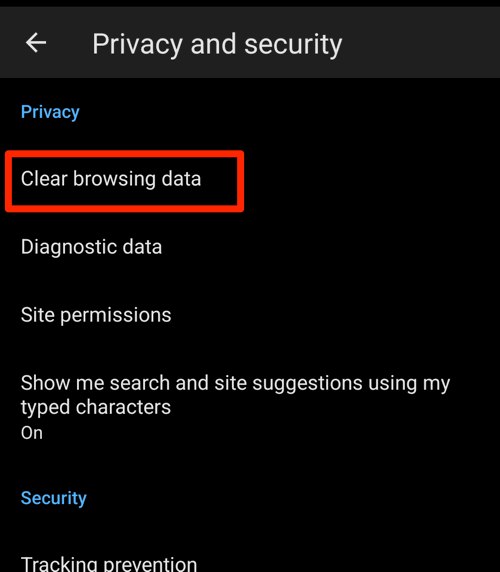
- Tap Privacy and Security, then open Clear browsing data.
- Select a Time range, then check Cookies and other site data and Cached images and files.
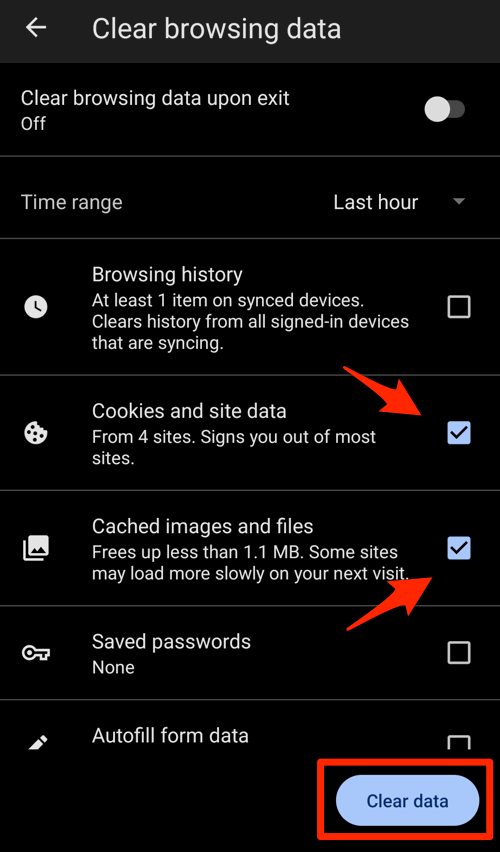
- Tap .
Edge deletes cookies and cache for the selected time range.
You’ll know it worked when the next page you load asks you to sign in again.
Need to remove cookies for just one site instead of all of them? Our guide to clearing browsing data in Edge on Android walks through the same menu in more detail.
Frequently Asked Questions
What’s the difference between first-party and third-party cookies?
First-party cookies come from the site in your address bar, like the sign-in cookie from your bank. Third-party cookies come from other companies, usually advertisers, that the first site loaded in the background.
Why does Edge block cookies on some sites I trust?
Tracking prevention can strip third-party cookies even when the main Cookies toggle is on. Switch it to Basic or Balanced if a trusted site cannot keep you signed in or load embedded widgets.
Do I need cookies enabled to sign in to websites?
Yes. Most sites use cookies to remember that you are signed in. With the global toggle off, you can still sign in for the current session, but the site forgets you the moment you close the tab.
What is the difference between cookies and cache?
Cookies are small text files a site uses to remember things about you, like your login. Cache is a copy of page elements and images that Edge stores locally so pages load faster next time. Clearing one does not clear the other, so if a login stops working, look at cookies first.