A flight, a dead zone, a train tunnel: three good reasons to keep a page on your own disk. Chrome's Save page as command writes an HTML copy plus a folder of supporting files, so the page still opens with no connection.
Open the page, let it finish loading, then pick Cast, save, and share > Save page as and choose Webpage, Complete. Keep the HTML file beside its folder and test it with Wi-Fi off.
In this guide, I have covered:
Contents
Watch: Saving a Page for Offline Reading
The clip below runs through the whole save in a desktop Chrome window, from the menu click to the folder that lands on your disk.

If the video shows the older More Tools route, use the current Cast, save, and share path in the steps below.
Save a Page as an HTML Document
You want the page on your disk before the signal drops, not in a tab you might close by accident. Chrome’s Save page as… command writes the page as an .html file and drops a folder of supporting files beside it.
Let the page finish loading first. Save too early and you keep whatever had painted by then, which is often half the article.
Google’s Read pages later and offline help page confirms the current desktop menu path.
- Open the webpage you want to keep in Google Chrome on your computer.
- Wait until the page and its visible images have finished loading.
- Click the
 menu in the top-right corner of Chrome.
- Hover over Cast, save, and share.
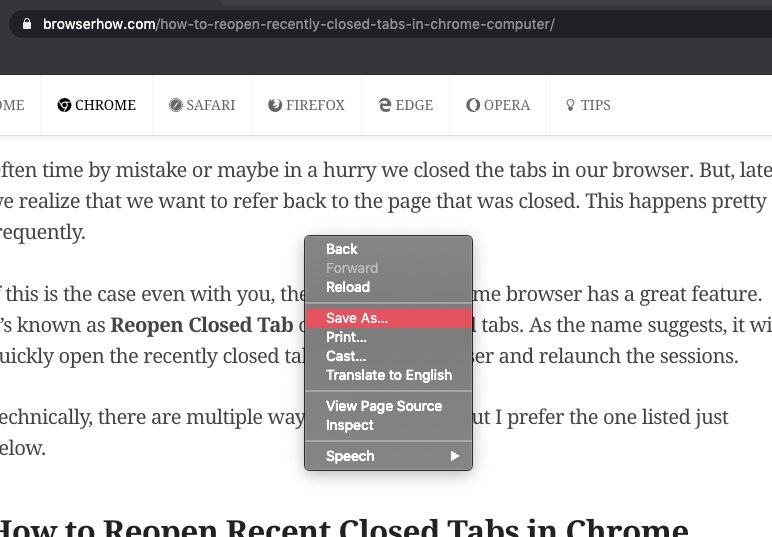
- Select Save page as….
- In the Save As dialog, choose a destination such as Downloads or Desktop.
- If Chrome shows a format list, select Webpage, Complete.
- Enter a file name.
- Click .
Chrome creates an .html file and a folder holding the page’s images and other local assets. Move the HTML file on its own and those images break, so keep the two together.
Save a Page From the Right-Click Menu
If the main menu is a hassle, or you simply right-click out of habit, Chrome puts the same command on the page itself.
- Right-click an empty area of the page, away from a link, image, or selected text.
- Select Save page as…. On some versions, the command is labeled Save as….
- If a format list appears, select Webpage, Complete.
- Choose a destination folder.
- Enter a file name.
- Click .
Files saved this way behave exactly like the ones from Chrome’s main menu: one HTML file, one supporting folder, and the same rule about keeping them side by side.
Open the Saved Page Without Internet
Saving only counts if the file opens when the connection is gone, so test it once before you actually need it.
Desktop Chrome does not open a saved HTML page from its Downloads list the way Chrome on Android does. You open the file from your computer, and Chrome renders it as a local page.
- Disconnect your computer from Wi-Fi or Ethernet.
- Double-click the saved .html file.
- If another browser opens it, right-click the file.
- Select Google Chrome from the available app choices.
- Check that the main text and saved images appear.
Chrome displays the captured HTML and the locally saved resources with no connection at all. Ads, embedded video, sign-in prompts, and some scripts still reach for the live site, so those parts can look blank or broken.
You’ll know it worked when the article text and its images show up with Wi-Fi switched off.
Working on a phone instead of a desktop? Downloading pages for offline reading in Chrome on Android takes a different route through the Downloads list.
Save a Page as a PDF for Offline Reading
Sometimes you want one file that looks the same on any screen, with nothing to keep track of. A PDF is that file, and Chrome builds it from the print preview.
Chrome’s print as PDF feature creates a copy of the page you are viewing right now.
- Open the page in Chrome.
- Press + on Windows or Linux, or + on macOS.
- In the print dialog, select Save as PDF as the destination.
- Click .
- Choose the destination folder.
- Enter a file name.
- Click again.
The finished PDF keeps a fixed layout. It does not preserve the page’s interactive controls, so treat it as a document to read rather than a page to use.
Bottom Line
The command to remember is Save page as…, and the format you want is Webpage, Complete. Save the HTML file with its supporting folder, then open it once with the connection off. That one test tells you more than any guide can.
On iPhone or iPad, you can add those pages to the reading list and read them offline later.

Frequently Asked Questions
These are the questions that come up most often once the file is saved.
Where is Save page as in Chrome on a computer?
Open Chrome’s menu, hover over Cast, save, and share, and select Save page as…. Older Chrome versions put the same command under More Tools.
Can Chrome download a full page for offline use?
It saves the main HTML document plus the resources it can capture. Live services are a different matter, so interactive parts can behave differently while offline.
Will every image and video be available offline?
No. Some elements are fetched from the live site rather than stored in the local folder. Embedded video, ads, sign-in prompts, and some scripts need a connection.
Can I open the saved page in Chrome later?
Yes. Open the saved .html file from the folder where you stored it, and keep it beside the matching supporting-files folder.
Should I save the page as HTML or PDF?
Use HTML for a browsable copy that keeps the page’s structure and images. Use PDF when you need one file to send, print, or archive without a folder beside it. Both open without a connection.