Edge gives you plenty of privacy and security controls, but switching off every permission can break sign-ins, payments, video calls, and embedded content.
Work from Privacy, search, and services instead: tighten tracking prevention, review site permissions and third-party cookies, keep SmartScreen on, and clear stored data only when you need to.
In this guide, I have covered:
Contents
Find the Edge privacy and security settings on your computer
You want Edge to collect less and hand out fewer permissions, but you still need your everyday sites to work. That is the balance to strike here, and the browser gives you enough control to manage it without switching everything off.
Start with the built-in controls. Tighten tracking protection first, then adjust access site by site.
- Open Microsoft Edge.
- Select the Settings and more
 menu.
- Choose Settings.
- Select Privacy, search, and services in the sidebar.
- Scroll to Tracking prevention, Privacy Guard, Site permissions, Third-party cookies, and Clear browsing data.
Microsoft changes these controls gradually, so their order and wording can differ slightly between Windows and macOS builds.
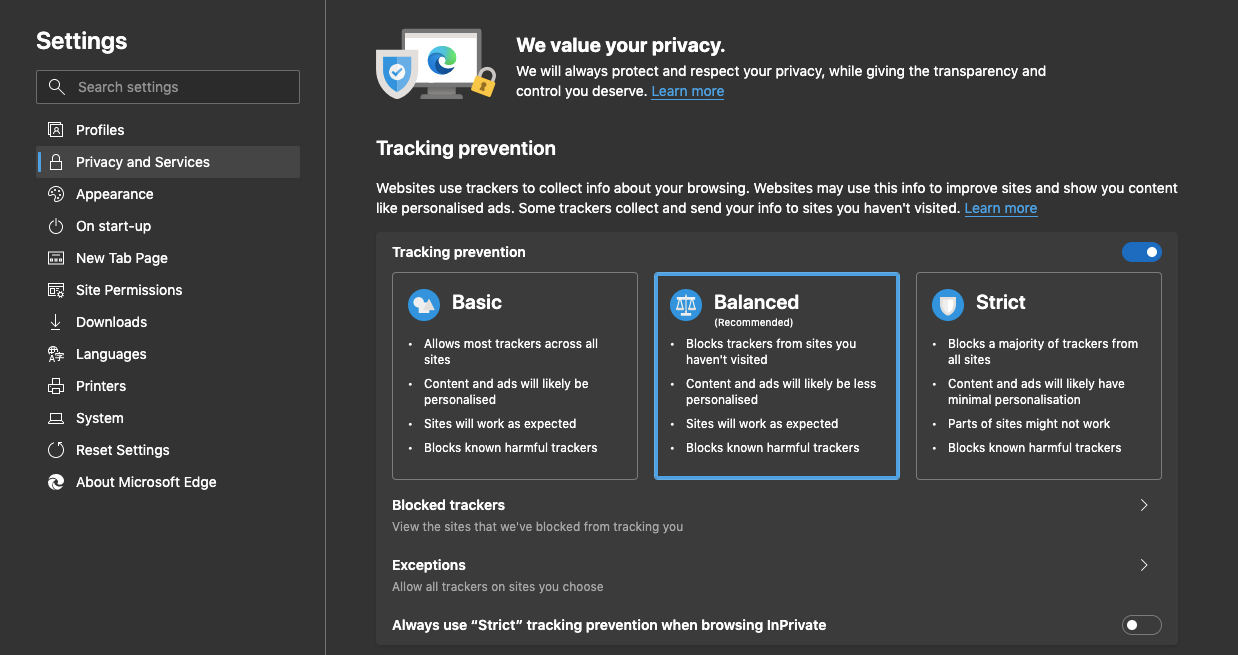
Strengthen Edge tracking prevention
If ads seem to follow you from one site to the next, tracking prevention is the setting doing most of the work.
Tracking prevention applies before a page loads, which makes it the broadest privacy control in Edge. Current builds offer Basic, Balanced, and Strict, and Balanced is the default.
- Open Privacy, search, and services.
- Select Tracking prevention.
- Read the descriptions shown for Basic, Balanced, and Strict.
- Keep Balanced as your starting point, or select Strict if you accept possible site breakage.
- Open a site you use often.
- Confirm that it loads without an unexpected warning.
Strict blocks more tracking activity than Balanced. When a sign-in, payment, video, or embedded element fails, keep the stronger setting for general browsing and add an exception for that one site.

Privacy Guard appears in newer Edge builds. Read its on-screen description and keep the recommended protection enabled unless a trusted workflow is blocked.
Edge on iPhone ships with a comparable set of privacy controls. If you browse there too, the strict privacy settings guide for Edge on iPhone covers the mobile side.
Review site permissions
Location, camera, microphone, notifications: each one is a separate switch, and most people set them once and never look again.
Site permissions is where those switches live. Current Edge uses this label, while older guides call the area Site Settings.
- Open Privacy, search, and services.
- Select Site permissions.
- Review Location, Camera, Microphone, Notifications, and the other listed permissions.
- Set each permission to Ask before accessing, Block, or Allow.
- Open a site’s entry when you need to override the global choice for that site only.
- Return to the site.
- Confirm that it asks for the required permission instead of failing silently.
Block permissions you never use, ask for sensitive access, and allow it only on trusted sites. A site exception is safer than opening a sensitive permission to the whole web.
If you also manage Edge on an iPhone or iPad, our guide to viewing site information and configuring settings in Edge on iPhone walks through the same review.
Control third-party cookies
When a site breaks after you block third-party cookies, it usually needs one exception, not a full rollback.
Third-party cookies let outside services follow activity across sites, so blocking them is worth a little upkeep.
- Open Privacy, search, and services.
- Select Third-party cookies.
- Choose Block third-party cookies for normal browsing, or In incognito only for a narrower setup.
- Open the list of sites allowed to use third-party cookies.
- Remove sites you no longer recognize or trust.
- Add an exception for a trusted site only when blocking causes a sign-in or embedded feature to fail.
- Reload the affected site.
You’ll know it worked when the site loads without a sign-in loop and third-party cookies stay blocked everywhere else.
Check Edge security protections
Privacy settings limit what sites collect. Security settings stop unsafe pages and downloads before they reach you.
Edge keeps the two in different places. Security covers protection from malicious sites and files, and on current desktop builds it has its own sidebar item.
- Open Settings.
- Select Security in the sidebar.
- If Security is not in the sidebar, return to Privacy, search, and services and look for it there.
- Confirm Microsoft Defender SmartScreen is enabled.
- Review Secure DNS and keep the default provider unless you intentionally use another trusted DNS service.
- Open a familiar website.
- Confirm that Edge does not display a security warning.
Do not disable SmartScreen to fix one troublesome site. Adjust that site’s permissions or cookies first.
Remove Edge extensions you do not trust
An extension you added months ago and forgot about can still read and change every page you open.
Turn off the ones you did not install, no longer recognize, or no longer need.
- Launch the Edge browser on your computer.
- Click on the More for the menu list, and select the Extensions menu.
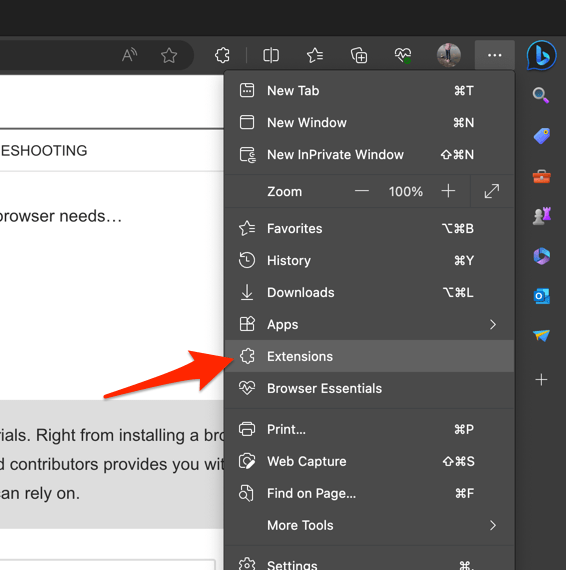 It will open the Edge browser's extensions manager page.
- Toggle the switch to Turn Off the extension in Edge browser.
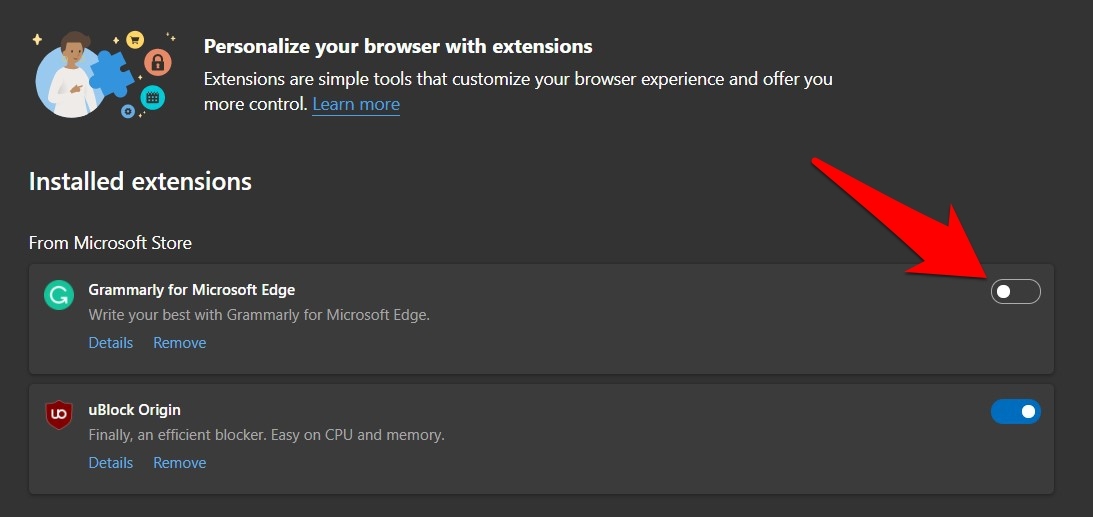
You’ll know it worked when the unwanted extensions are off and the sites that rely on the remaining ones still behave as expected.
Clear cookies and cached files
A shared computer, a page stuck on old content, a sign-in that refuses to clear: this is the cleanup for those cases.
Clearing cookies signs you out of websites and can reset site preferences, so do it when you need to rather than on a fixed monthly schedule.
- Open the Edge browser on computer.
- Click on the More for the menu list, and select the Settings menu.

- Switch to the Privacy, Search, and Services tab from the left sidebar.
- In the Right side pane, under the Clear browsing data section, click the button.
 It will open a Clear browsing data window.
- Select the Time Range from the drop-down, and enable the checkboxes for the 'Cookies and other site data' and 'Cached image and files' options.
- Finally, hit the button.
 It will delete the cache and cookies stored for all sites from the Edge browser.
You’ll know it worked when the affected sites load with fresh data and you have a short list of accounts to sign back into.
Clear Edge browsing history
Sometimes you want the list of pages and searches gone, but you would rather stay signed in everywhere.
History is stored separately, so you can clear it without touching cookies or cached files.
- Launch Edge browser on your computer.
- Click on the More menu and select the Settings menu.
- Switch to the Privacy, Search, and Services tab from the left sidebar.
- Under the Clear browsing data section, click the button.
- Select the Time Range and enable the checkbox for the Browsing History option.
- Finally, hit the button.
 It will delete the history records from the computer browser.
You’ll know it worked when the selected time range no longer appears in Edge history and your saved passwords and settings are unchanged.
For a complete cleanup or a browser reset, see our guide to clearing the browsing data.
Fix a site that stops working after a privacy change
A page that loaded fine yesterday now hangs at sign-in or shows an empty video frame.
Stricter privacy settings tend to expose sites that depend on a cookie, tracker, or permission. Make the smallest exception that restores the missing feature instead of disabling every protection.
- Reload the site.
- Note whether sign-in, payment, video, or embedded content is missing.
- Open Privacy, search, and services.
- Select Site permissions.
- Allow only the specific permission the failed feature needs for that site.
- Return to Third-party cookies.
- Add a site exception if the page still fails to load.
- If the site still fails, switch Tracking prevention from Strict to Balanced for the test.
- Restore the stricter setting if possible after confirming what fixed the site.
If you use Edge on Android as well, you can apply a matching privacy and security checklist on Android.

Frequently Asked Questions
Which Edge privacy setting should I change first?
Start with Tracking prevention. Balanced is the default, while Strict blocks more tracking activity but can affect sites that rely on third-party content. Review Site permissions and Third-party cookies next.
Why does a website fail after I choose Strict tracking prevention?
A site may depend on a tracker, cookie, or permission that the new setting blocks. Add a narrow exception for that site, or use Balanced temporarily while you identify the missing feature.
Should I clear cookies and cache every month?
No fixed interval is required. Clear the data when you share a computer, when a site shows stale content, or when you want to sign out of saved sessions. Expect to sign in again after clearing cookies.
Where is Microsoft Defender SmartScreen in Edge?
Open Settings and select Security. On some builds, the Security section appears within Privacy, search, and services instead. Keep Microsoft Defender SmartScreen enabled for normal browsing.
Does Strict tracking prevention block all third-party cookies?
No. Tracking prevention and third-party cookie controls are separate in Edge. A site can still need cookies even when tracking protection is set to Strict.