Edge collects history, cookies, and cached files as you browse, and sometimes you want that trail gone. On a computer, the cleanup lives in privacy settings, while a settings reset solves a different problem entirely.
Check the time range and the data types you ticked before you confirm either action, so you do not lose active sign-ins or saved passwords.
In this guide, I have covered:
Contents
Clearing data or resetting Edge: which one do you need?
Something is off in Edge and you are not sure whether to clear your data or reset the browser. They are separate controls, and picking the wrong one just wastes time.
Clearing browsing data removes history, site sessions, or cached files. Resetting settings changes how Edge behaves, covering startup pages, the search engine, and extensions. A reset leaves history and cookies alone.
The cleanup lives under Privacy, search, and services, in the Clear browsing data now section with its button. The reset has its own Reset settings page near the bottom of the settings sidebar.
Clear browsing history in Edge on your computer
Say you want Edge to forget a specific stretch of visits, an hour’s worth or all of last month. History clearing does that and stops there.
- Launch Edge browser on your computer.
- Click on the More
 menu and select the Settings menu.

- Switch to the Privacy, Search, and Services tab from the left sidebar.
- Under the Clear browsing data section, click the button.

- Select the Time Range and enable the checkbox for the Browsing History option.
- Finally, hit the button.
 It will delete the history records from the computer browser.
You’ll know it worked when the History page, which opens with + , no longer lists entries from the range you picked.
We usually suggest a narrow range first, like the last hour, so you can confirm nothing you need vanishes.
Cookies, cached files, and saved passwords stay put unless you tick those boxes in the same dialog.
Clear cookies and cached files in Edge
One site keeps signing you out, or a page still shows the layout you fixed days ago. Cookies and stale cache files are the usual suspects.
- Open the Edge browser on computer.
- Click on the More for the menu list, and select the Settings menu.
- Switch to the Privacy, Search, and Services tab from the left sidebar.
- In the Right side pane, under the Clear browsing data section, click the button. It will open a Clear browsing data window.
- Select the Time Range from the drop-down, and enable the checkboxes for the 'Cookies and other site data' and 'Cached image and files' options.
- Finally, hit the button.
 It will delete the cache and cookies stored for all sites from the Edge browser.
You’ll know it worked when the site asks you to sign in again and the page rebuilds from a fresh download.

TIP: That first load feels slower. Edge has to fetch images, scripts, and stylesheets you just deleted, so give the page a moment before you assume something broke.
If you want it done in one pass, the same dialog clears Browsing history, Cookies and other site data, and Cached images and files together. Pick All time to reach every stored item. A shorter range clears only what falls inside it.
Check what clearing Edge data changes
Before you hit confirm, it helps to know what disappears and what survives. Cookies are where most of the surprises come from.
Clearing Cookies and other site data signs you out of every affected site. Saved passwords stay in Edge, so signing back in is usually a couple of clicks. Our guide to password and sign-in data shows what Edge stores and how to review it.
Form autofill entries sit outside cookies too. Look at form auto-fill data if you want to see what Edge keeps before a broad cleanup.
Reset Edge settings on your computer
A changed homepage, a search engine you never picked, toolbars you don’t recognise: a reset puts Edge back to defaults. It is not a cleanup tool, which is where people get confused.
The Reset settings page holds Restore settings to their default values. That’s the control you want.
- Launch the Microsoft Edge browser.
- Open edge://settings/resetProfileSettings in the address bar.
It will open the reset browser confirmation dialog box. - Hit the button to confirm the browser reset.
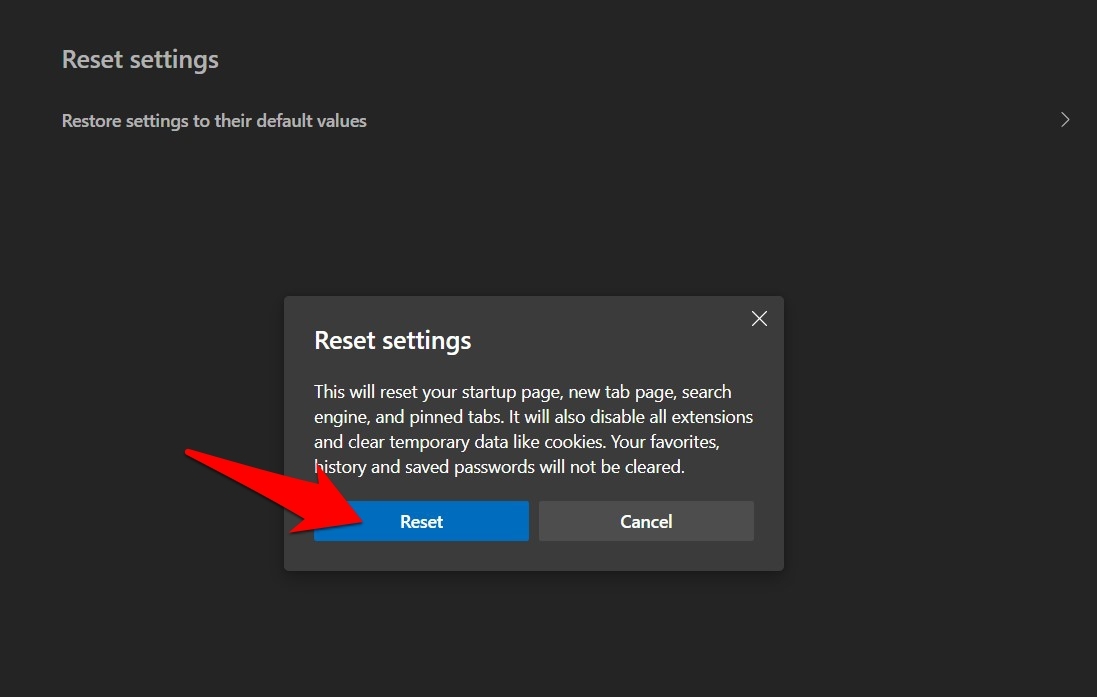 It will reset the Edge browser to the original default, clearing the temporary data and disabling all extensions.
You’ll know it worked when Edge reopens on the default new tab page, with extensions switched off and your startup pages gone.
A reset can clear temporary cache files on the way through. History and cookies survive, and so do favorites, autofill entries, and saved passwords.
Your Microsoft account and synced items are untouched. Use Sign in to Microsoft Edge and Manage Sync Data across devices if you want to check what Edge keeps in sync.
Clear Edge browsing data on other devices
Your phone has Edge on it too, and those settings look nothing like the desktop ones. Follow the guide to clear the browsing data from Edge in Android when you want the same cleanup there.
The controls sit in the app’s own settings, not in the desktop menu you just used.

Frequently Asked Questions
Does resetting Edge delete browsing history and cookies?
No. Resetting Edge restores browser settings and disables extensions, but it does not clear browsing history or cookies. Clear those items separately if you want them removed.
Why am I signed out after clearing Edge data?
Clearing cookies and other site data removes the sessions that keep websites signed in. Saved passwords remain in Edge unless you remove them separately.
Where is Clear browsing data in Microsoft Edge?
The controls are under Settings > Privacy, search, and services > Clear browsing data. The button opens the dialog, and the internal page edge://settings/clearBrowserData opens the same controls.
Will clearing the cache make Edge faster?
Not always. Clearing cached files can fix a page that loads outdated content, but it does not guarantee a general speed increase. The first visit after cleanup may be slower while Edge downloads the files again.