

Need to read a guide or reference page when the connection drops? Microsoft Edge can keep a copy on the computer, and the file type you pick decides whether images and styling come with it.
Press Ctrl + S (or Cmd + S on a Mac), choose Webpage, Complete, and open the saved HTML file to check what still works offline.
In this guide, I have covered:
Contents
Save a webpage in Edge for offline reading
That guide you keep meaning to read, or the reference page you need on a flight with no Wi-Fi, only helps if you grab it while the connection is still there. Saving in Edge copies the page to your computer, and the copy opens without a network.
To save pages for offline access in Edge on the computer, open the page first and give it a moment to finish loading. Images and stylesheets that haven’t arrived yet won’t make it into the copy.
- Open the webpage in Microsoft Edge and wait until the page finishes loading.
- Press + on Windows or + on macOS.
- In the Save As dialog, choose the folder where you want to keep the page.
- Enter a file name for the saved page.
- Choose Webpage, Complete from the file type or format list.
- Click .
Edge writes two things: an HTML file and a folder of supporting assets. Keep them side by side when you move the copy to another drive, a USB stick, or a second computer.

You’ll know it worked when the folder you picked holds a file ending in .html and, for Webpage, Complete, a matching folder beside it.
Find Save page as in the Edge menu
No keyboard shortcut, or the keys did nothing? Start from the Edge menu instead. Microsoft Edge has moved this command between submenus in different releases, so knowing both spots saves you the hunt.
Look for Save page as… under Print and save. Some builds place it under Cast, copy, and share instead.
- Open the webpage in Microsoft Edge and wait until it finishes loading.
- Click the
 menu in the upper-right corner.
- Choose Print and save. If that submenu is not available, open Cast, copy, and share instead.
- Choose Save page as….
- Choose the folder where you want to keep the page.
- Enter a file name.
- Choose Webpage, Complete from the file type or format list.
- Click .
Either path lands you in the same Save As dialog, so the format decision in the next section still applies.
Choose the file type that should work offline
Two entries in that dialog look nearly identical and behave nothing alike. The format decides whether images and styling travel with the HTML or stay behind on the web.
Webpage, Complete
This saves the page’s HTML along with the images, stylesheets, and other supported files, tucked into a separate folder. Pick it for anything you actually plan to read later, since the copy keeps far more of the original layout.
Webpage, HTML only
This keeps the main HTML document and skips the asset folder. Choose it only when you want a deliberately lightweight copy and care about words rather than looks. Images and much of the formatting will be missing offline.
For a page you need to read later, select Webpage, Complete. If the page leans on a live service, such as a sign-in form, comments feed, map, or video player, no saved format replaces that connection.
Open the saved page and check it without internet
A saved copy is a local file, not a live copy of the site. Test it once, before the day you actually need it, so a missing image doesn’t surprise you mid-flight.
- Open the folder where you saved the page in File Explorer on Windows or Finder on macOS.
- Find the saved .html file.
- Disconnect the computer from the internet temporarily.
- Right-click the saved file and choose Open with.
- Select Microsoft Edge.
- Check that the main text appears and that the important images load.

TIP: A saved page can look whole while you’re online and lose its images the moment the connection drops, because some files still load from the live site. Testing with Wi-Fi off is the only way to know what you really have.
Text loads but images don’t? Go back to the Save As dialog and save again as Webpage, Complete. Reconnect the computer when the test is done.
Know what an offline page can and cannot do
A saved page freezes the moment you save it. Anything the site adds afterward, new comments, updated prices, a refreshed dashboard, won’t be in your copy.
Text and the files Edge downloaded for that page are available locally. Content that scripts, advertisements, or live feeds pull in later usually isn’t.
Links are the bigger surprise. They still point at the live web, so following one without a connection fails unless you saved that destination too. Anything that needs an account, a server, or live data, including email, shopping carts, maps, and dashboards, may stay incomplete.
Saving one page does not save the whole site. For a full archive, save each page you expect to open and keep its supporting folder beside the .html file.
Save from the page’s right-click menu
You’re already looking at the page, so why move to a menu? Right-click opens the same Save As dialog, with the same format list.
- Open the webpage in Microsoft Edge.
- Right-click an empty area of the page, away from a link, image, or selected text.
- Choose Save as… from the context menu.
- Choose the folder where you want to keep the page.
- Enter a file name.
- Choose Webpage, Complete from the file type or format list.
- Click .
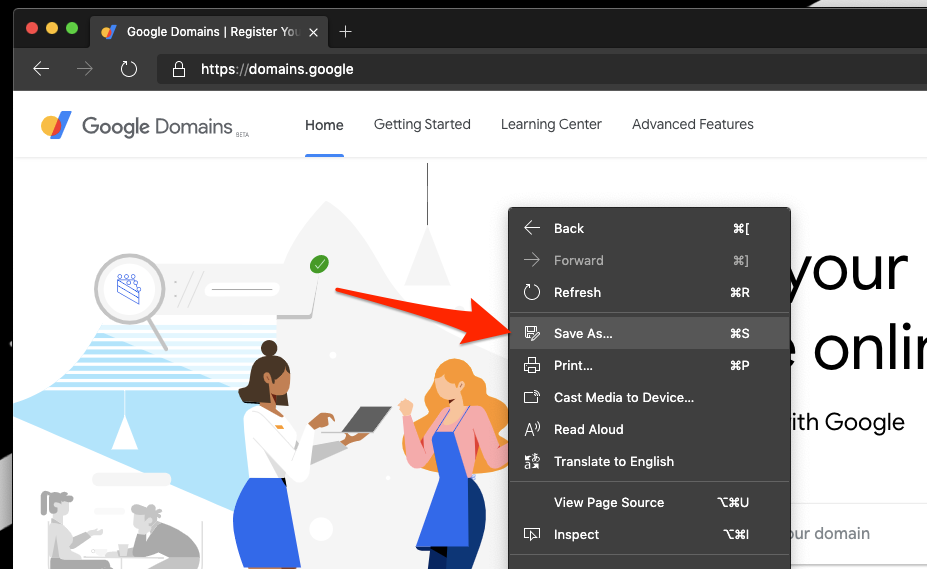
Same file, same folder, same result as + . Only the starting point changed.
Use a PDF when you need a fixed copy
Sometimes the copy has to look identical on every device, and a browsable HTML file isn’t the right fit. Edge’s print function covers that: you can print as a PDF option, which converts the page into a PDF for archiving or sharing.
A PDF keeps the layout fixed but drops the interactive behavior. Use the complete HTML copy when you want to move between saved pages.
Save pages offline on other Edge devices
Your desktop copy stays on the desktop. If you read on an iPhone or iPad too, that device needs its own copy, and Edge handles the task differently there: Download Pages for Offline Access in Edge on iPhone & iPad.
Saved pages don’t sync between devices, so make the copies on each one you’ll read from.

Frequently Asked Questions
Can I save a webpage in Edge for offline use on a computer?
Yes. Open the page and press + on Windows or + on macOS, choose Webpage, Complete, and click .
Where is Save page as in Microsoft Edge?
Open the menu, choose Print and save, then select Save page as…. If your Edge build groups it under Cast, copy, and share, use that submenu instead.
Which file type should I choose for offline access?
Choose Webpage, Complete. It saves the HTML and the downloaded supporting files. Webpage, HTML only leaves those assets out, so important images may be missing.
Will a saved Edge page work completely without internet?
The saved HTML and downloaded assets usually load, but scripts, live feeds, videos, sign-in tools, and links to other pages can still require a connection.
Does saving one page in Edge download the whole website?
No. It saves one page and the files Edge downloaded for that page. Save the other pages you expect to open separately.


Sorry, the instruction is very bad. File has no image 🙁
Hi Mile, we didn’t understand what was the problem. Can you please elaborate on the statement – File has no image?
The instructions provided are accurate with screenshots.
Incorrect, when you get to the save dialog, you must click the drop down menu and change save as type: from webpage html only to Webpage complete, complete in order to get the complete page with images.