

Chrome and Edge share the same Chromium engine, so most pages load and behave the same way in both. The gap shows up in account sync, privacy defaults, and the tools each browser ships with.
Pick Chrome if your work runs on Google services. Pick Edge on Windows or Microsoft 365, especially if you want tracker blocking on by default.
In this guide, I have covered:
Contents
Chrome or Edge: Which Browser Should You Use?
Chrome and Edge are closer than their brand names suggest. Both run on Chromium, so modern sites, extensions, and everyday speed behave much the same way in either one. The choice comes down to your accounts, your privacy settings, and the tools each browser builds in.
Short version: Chrome is the easier default if your life runs on Google services. Edge fits Windows and Microsoft 365 users who want tracker blocking switched on from day one. For ordinary browsing, they are close to a tie.
This comparison covers the desktop versions. The mobile apps carry the same names but hide different menus and skip a few features.
Want to test both on the same machine? Grab the current installers from the Google Chrome download page and the Microsoft Edge download page.
Quick Comparison: Chrome vs. Edge
Skimming for the short answer? Only a few factors decide a daily browser choice. Where the table says tie, the better result depends on your setup and what you care about most.
| Factor | Google Chrome | Microsoft Edge | Better Fit |
|---|---|---|---|
| Core engine | Chromium | Chromium | Tie |
| Best fit | Google Workspace and Chrome-first workflows | Windows, Microsoft 365, and tracker blocking by default | Your ecosystem |
| Performance | Fast, with Memory Saver and Energy Saver | Fast, with close Chromium performance | Near tie |
| Privacy | Safe Browsing and third-party cookie controls | SmartScreen and Balanced or Strict Tracking Protection | Edge for defaults |
| Built-in tools | Translate, password manager, and Listen to this page | Read aloud, immersive reading, and Microsoft integrations | Tie by workflow |
| Extensions | Chrome Web Store | Edge Add-ons and compatible Chrome Web Store extensions | Depends on the required tool |
| Recommendation | Best for Google users | Best for Microsoft and privacy-conscious users | Your priorities decide |
How We Compared Chrome and Edge
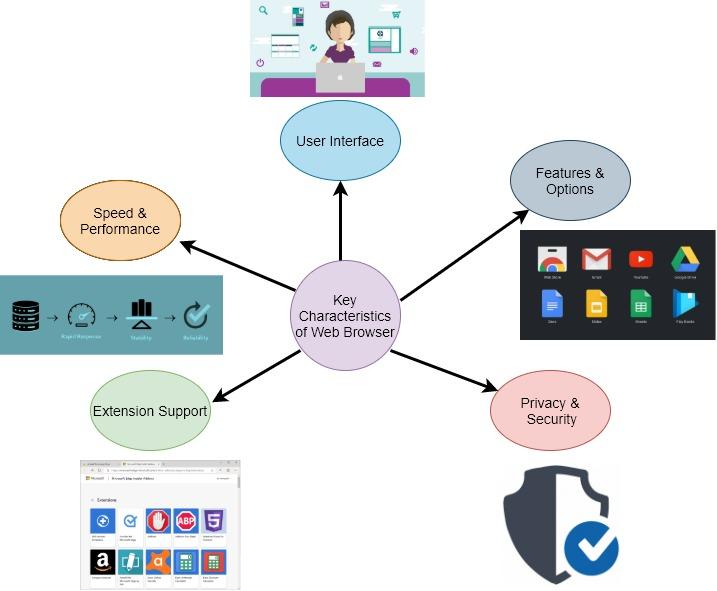
A single lab speed test will not tell you which browser is better for normal use. We looked at the interface, built-in features, performance controls, privacy and security defaults, and extension support, then scored each category on its own.

Our Review Process: We consider various parameters for review, which include but are not limited to ease of usability, built-in features, popularity, user rating, frequency of updates, support, and most importantly, customer satisfaction. We rate the products or services compared to its peers under the same category. Hence, a product/service rating on Page 'A' can be different than Page 'B'.
Each category gets a clear winner only where there is a meaningful gap. When the better choice depends on your hardware, account, or workflow, we call it a tie and explain why.
Your next step: read the scores as a starting point, then weight the two or three categories that match how you actually browse.
Browser Usability and User Interface
Switching browsers means relearning small habits: where tabs live, how profiles work, and how many clicks it takes to sign in. This is the category where Chrome and Edge are hardest to separate.
Our winner: Tie
Microsoft Edge: Edge keeps the plain Chromium layout but adds vertical tabs, separate profiles, a configurable new-tab feed, and a short import flow. Cross-device Send tabs pushes a page from one signed-in device to another.
Google Chrome: Chrome gives you tab groups, profiles, a compact toolbar, and an import flow for moving in from another browser. It also supports sending tabs to a different device, though Edge now does the same kind of cross-device tab sharing.
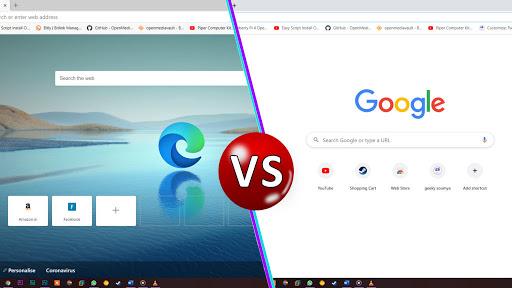
Mostly preference, then. If you like vertical navigation, Edge will feel natural faster. If you live in tab groups, it may work the other way round.
Accounts, Sync, and Ecosystem
The account you already use can outweigh every small interface difference. Chrome syncs through a Google account and plugs straight into Google services. Edge syncs through a Microsoft account and slots into Windows and Microsoft 365.
You can browse in either one without signing in. Sign in, and bookmarks, passwords, history, and open tabs follow you between devices. If you are moving from Chrome, Transfer the Saved Data from Google Chrome to Microsoft Edge walks through bringing your data across.
Built-in Features and Options
Built-in tools matter when you would rather not install another extension for every small job. The interesting comparison now is between ecosystems and workflows, not a checklist of isolated features.
Our winner: Tie
Microsoft Edge: Edge includes immersive reading for a cleaner article layout, and its read-aloud tool turns any page into spoken audio. On Windows and inside Microsoft 365, the Microsoft integrations are genuinely useful.
Google Chrome: Chrome ships with Google Translate, a password manager, and Listen to this page on current desktop builds. If you work in Docs, Drive, and Translate all day, Chrome is the more natural fit.
Edge’s reading tools are no longer exclusive. Chrome reads pages aloud too, so that feature alone no longer gives Edge the win.
Browser Speed and Performance
Fast page loads are nice, but they rarely settle an argument between two Chromium browsers. Your connection, the site itself, installed extensions, and the number of open tabs move the needle far more.
Our winner: Tie
Chrome’s Memory Saver frees resources from inactive tabs, so RAM is not wasted while you work. Chrome also has a separate energy consumption control on supported systems.
Edge can feel lighter on some Windows machines, particularly older or memory-limited ones. That is not a universal rule, though. Extensions and heavy web apps usually explain why one browser feels faster on a given computer.
For a typical user, both are quick. Run your normal tabs and extensions in each for a day. That will tell you more than any benchmark.
Browsing Data Privacy and Connection Security
How much tracking gets blocked before you touch a single setting is where these two part ways. On security, they are close.
Our winner: Edge for default privacy controls, with security close to a tie.
Microsoft Edge: Edge uses Microsoft Defender SmartScreen and warns you on insecure connections. Its Tracking Protection offers Balanced and Strict modes, which limit the trackers that follow activity across sites.
Google Chrome: Chrome offers Safe Browsing, HTTPS warnings, third-party cookie controls, and Incognito. Those give you strong control, but Chrome does not block every tracker by default.
Edge’s reputation for late updates is out of date. Microsoft ships Edge updates on a regular two-week cycle, and Chrome gets regular stable updates too. Keeping either browser current matters more than update history.
Private mode is not a force field, and neither is a single security toggle. Regular updates, unique saved passwords, and a careful look at extension permissions do most of the real work.
Third-party Extension Support
Your extension list may decide this for you. Both browsers handle popular extensions well, but the stores and the setup around them differ.
Our winner: Tie for compatibility, with Chrome ahead for Chrome-specific workflows.
Because Edge is built on Chromium, compatible Chrome Web Store extensions also work on Edge. Edge runs its own add-ons collection as well.
Before switching, check Edge’s extension library if you depend on security, productivity, or accessibility tools. Chrome’s list of extensions is the better hunting ground for tools built specifically around Chrome.
Install Chrome Web Store Extensions in Edge
If a single Chrome extension decides your choice, install it in Edge on the same computer before you move your whole setup.
- Open Microsoft Edge and visit the Chrome Web Store.
- Search for the extension you want and click the listing to open its install page.
- Click the Get extension button on the banner at the top of the page. Edge replaces the standard "Add to Chrome" label with this button when it detects Edge.

- If Edge shows a small dialog asking to allow extensions from other stores, click Allow. Edge remembers this choice for future Chrome Web Store installs.
 The extension downloads in a few seconds. Its icon appears next to the address bar, or inside the Extensions menu if the extension has no toolbar button.
You’ll know it worked when the extension icon appears next to the address bar or shows up in the Extensions menu. If Edge asks for permission to use extensions from another store, allow it only when you trust the publisher.

Bottom Line
Still deciding? For most people, Chrome is the more natural default. That is especially true if you use Google Workspace, depend on Chrome-specific extensions, or want the same experience across desktop and mobile.
Edge is the better fit on Windows, inside Microsoft 365, or for anyone who wants tracker blocking and reading tools without adding extensions. Its regular update cycle removes one of the old reasons to avoid it.
Test both with your usual sites, your account, and your extension list before you commit. Shared Chromium DNA makes the gap smaller than the branding suggests.
Frequently Asked Questions
Is Chrome or Edge better for everyday use?
Chrome suits most Google-account users, while Edge suits Windows and Microsoft 365 users. Both are fast, compatible with modern sites, and regularly updated.
Which browser is more private, Chrome or Edge?
Edge has the default-setting advantage because Tracking Protection includes Balanced and Strict modes. Chrome offers strong safety and cookie controls, but tracker blocking still depends on your choices.
Which is faster, Chrome or Edge?
Performance is usually a near tie because both use Chromium. Extensions, open tabs, site complexity, and your device’s available memory have more effect than the browser name.
Can I use Chrome extensions in Microsoft Edge?
Yes, most Chrome Web Store extensions can be installed in Edge, and Edge also offers its own add-ons. Check the publisher and permissions before granting access.
Can I transfer bookmarks and passwords from Chrome to Edge?
Yes. Edge can import bookmarks and saved passwords from Chrome. Keep a backup of the original data until your bookmarks, folders, and passwords appear correctly.

I use edge and it is far better than chrome. Compared to edge, chrome is a trash
I have found that the same search is getting far more results in Edge than in Chrome. For instance: When I search “elation led60wa” (an led stage light), Chrome gives me two listings of the same secondhand website. Whereas Edge brings up multiple options, including the manufacturer’s page! Also shows sites that have the manual, etc. Why is Chrome so limited now? I’ve always used Chrome, but I’m finding many of my searches are like this…
Yes, that tipped the scale for me, too.
Of course, one can do a Bing search from Chrome, but it showed me that my long aversion to anything Microsoft was outdated.
Honestly, a month into it I’m still marveling at my switch of allegiance.
Tried out Edge again recently and wow… This is a wash, Edge has even fixed my major gripe with Chrome – working full screen browsing. Edge is Chrome+. First time in 20 years or so that a Microsoft browser is my main browser.
Microsoft Edge is any day much better now
google chrome better
but i like microsoft edge because its faster than google chrome
So Google Chrome was a good choice but heavy memory so I agree with Chrome and Edge is Trash.
I have long since broke ties with Google services so I mostly used Chrome without a Google account. When Edge Chromium came out I was completely hooked on it vs Chrome and don’t even find a need to have Chrome on my Mac’s mostly because Chrome is a horrible RAM hog. It’s better on a Windows 10 PC but still worse than Edge. I can see how users still married to Google services will stick with Chrome. Obviously all those Chromebook’s are stuck as well with Chrome. But I am very happy with Edge and don’t see a reason to go back to Chrome.
High CPU usage problem recently with my AIO HP Desktop.
Just found out the culprit: Chrome.
I’ve switched to Edge and everything is running smoothly now.
Thank you so much for your wonderful information. Never heard anything like this before, now I realize that I have to learn a lot from people like you to know which browser is better and safer.
Thank you.
Edge is best, no second thoughts.
Chrome is basically spyware for Google. Bye!
Meanwhile Edge is also spyware for Microsoft. XD