

Microsoft Edge for Android is Microsoft's Chromium-based mobile browser. It uses the same engine as Google Chrome, so most sites behave the same way, but Microsoft adds features you won't find in a plain Chrome install.
You get built-in Copilot, an integrated ad blocker, Microsoft Defender SmartScreen protection, and sync for tabs, passwords, and history across devices. If you already live in Microsoft services, or just want a Chromium browser with more built-in tools, Edge is worth a look.
In this guide, I have covered:
Contents
What is Microsoft Edge for Android?
If you already use Edge on a Windows PC, Microsoft Edge for Android brings the same browser to your phone. It runs on Chromium, the same engine as Google Chrome, so most websites work the way you expect.
The mobile app adds a built-in Copilot assistant, an integrated ad blocker, Microsoft Defender SmartScreen phishing protection, and tighter integration with Outlook, OneDrive, and Microsoft 365. Sign in and Edge syncs tabs, history, passwords, and favorites across your phone, PC, and other devices.
Edge for Android is free from the Microsoft Edge page on the Google Play Store and works on Android 8.0 or newer. If you live inside Microsoft services, or just want a Chromium browser with more included tools, it earns a spot on your home screen.
How to download and install Edge for Android
If you want Edge on your phone, start with the Play Store. The app installs like any other Android app.
- Open the Google Play Store on your Android device.
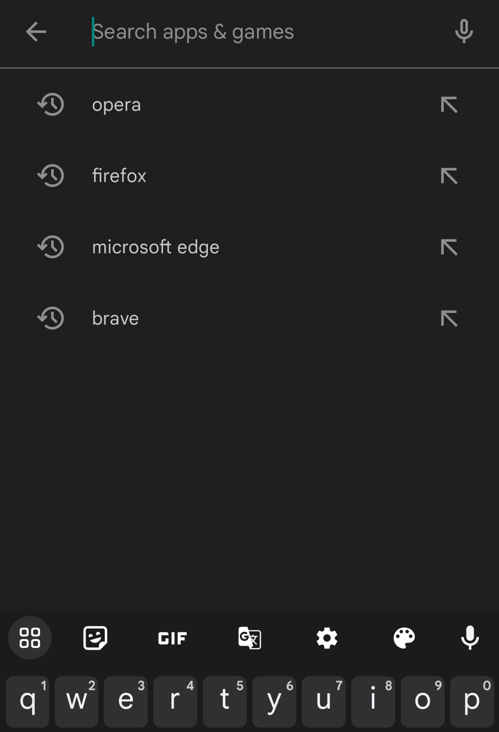
- Next, search for the Microsoft Edge app in the search bar from the top and select it from the results list.
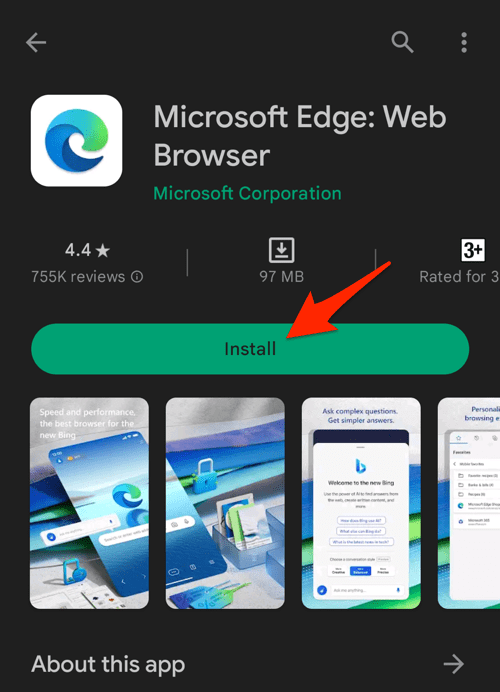
- Tap the button to download and automatically install the Edge app.
- After installation, tap the button to launch the browser.
When the install finishes, tap Open in the Play Store or launch the Edge icon from your app drawer. You’ll know it worked when the welcome screen appears and asks you to sign in or skip for now.
Sign in with a Microsoft, Google, or work account
If you want your phone and PC to share tabs, passwords, and history, sign in when Edge first opens. You have three account options: a Microsoft account, a Google account (added in late 2026 as a personal-account alternative), or a work or school account through Microsoft Entra ID.
Signing in syncs tabs, browsing history, passwords, addresses, and favorites across every device using that same account. You can also stay signed out and run Edge as a local browser with no data leaving your phone.
The profile icon sits in the top-left corner of the new tab page. Tap it to switch profiles, sign out, or add another account. Work and personal profiles stay in separate browsing containers, so work data does not mix with personal browsing.
Homepage layout: search bar, top sites, and news
If the new tab page feels cluttered, you can change it. The Edge for Android homepage is one of the most customizable start pages on a mobile browser, with individual cards you can toggle and arrange.
The default layout includes a search bar, top sites, a Microsoft News feed, a content card, and a quick-link grid. Prefer a quieter start page? Switch to the custom layout and turn nearly all of it off.
Our Edge homepage layout guide walks through each card. You can also change the search engine in Edge for Android if you want a different default.
Bottom toolbar and address bar position
Tall phones make top controls hard to reach. Edge for Android answers by putting navigation, the tab switcher, share, and menu in a bottom bar by default.
You can move the address bar down too. Go to Settings, Appearance, Address bar position, and choose Bottom to keep back, forward, and reload within thumb’s reach. The Top option restores the classic layout.
Swipe navigation adds another one-hand option. Turn it on from Settings, then Privacy and security, then Swipe to navigate. After that, swipe sideways across the page instead of tapping the back button.
Tabs, tab groups, and InPrivate browsing
If research on a phone gets messy, the tab tools help. Tap the tabs icon in the bottom bar to open the grid, then open new tabs, close one tab, or close everything with a single tap.
For a private session, long-press the tabs icon and Edge jumps into InPrivate. InPrivate browsing does not save history, cookies, or form data after you close the tabs, much like Chrome’s Incognito mode. See opening new tabs and InPrivate tabs in Edge for Android for the full walkthrough.
Tab groups work on mobile too. Long-press a tab in the grid, choose Add to group, and Edge lets you name and color-code that group so related tabs stay together.
Copilot: your built-in AI assistant
If you want a page explained without reading all of it, Copilot is the fastest option. It lives in Edge’s sidebar and opens with a tap from any page.
Ask Copilot to summarize a long article, condense several open tabs, summarize a video you are watching, or answer follow-up questions about the page. Vision mode lets you point the camera at something and ask about it in real time.
On the new tab page, the search bar can route your query to Copilot for chat-style answers or to the web when you need links. Copilot is free with a Microsoft account, and signing in unlocks longer conversations and history across devices.
Reading mode, Read Aloud, and Immersive Reader
Edge gives you three reading tools, but each solves a different problem.
Reading mode strips ads, sidebars, and most images so you see clean text. Read Aloud then speaks that clean text through a built-in voice. Immersive Reader goes further with text spacing, syllable breaks, a picture dictionary, and line focus.
On a supported page, you can open Immersive Reader straight from the address bar:
- Open the article you want to read in Microsoft Edge on Android.
- Look at the right end of the address bar for the Enter Immersive Reader book icon.
- Tap the book icon. The page reloads into the reader layout.
- If no icon appears, jump to the text-selection or read: prefix method below.
You’ll know it worked when the article reopens in a clean text view with extra reading controls. If the book icon is missing, long-press a paragraph and choose Open in Immersive Reader from the selection toolbar. You can also type read: before a URL (for example, read:https://example.com/article) and load it to force the reader view.
Sharing across devices: Continue on PC and Edge Drop
You found a page on your phone and need it on your computer. Edge handles that with Continue on PC in the bottom bar share menu. The current page opens as an active tab in your signed-in desktop browser.
Need to send a file or note instead? Open the  menu, pick Drop, and add a link, note, or file from your phone. It shows up in the Drop sidebar in Edge on your PC, and the reverse works too. This is handy for moving screenshots, snippets, and quick links between devices.
Privacy and security: AdBlock Plus and SmartScreen
Edge includes two safety layers that work on their own. The first is AdBlock Plus, which blocks intrusive ads on sites that violate the Better Ads Standards. It is on by default under Settings, Privacy and security, Block intrusive ads.
The second is Microsoft Defender SmartScreen. It checks each URL you visit against a constantly updated list of phishing and malware sites. A known bad page triggers a full-screen warning before you continue. SmartScreen also scans downloaded files.
Tracking prevention gives you Basic, Balanced, or Strict levels, similar to Chrome’s tracking protection. You can also turn on Send Do Not Track from the same menu, although most sites ignore that signal.
Cross-device sync for tabs, history, and passwords
Sync is what makes Edge feel like one browser across devices. Sign in and Edge syncs open tabs, browsing history, saved passwords, addresses, payment methods, favorites, and your reading list across every device on that account.
To see PC tabs on your phone, tap the tab icon in the bottom bar and scroll to Your devices. Tap a device and the page opens in a new tab. On the desktop, phone tabs appear in the Mobile section of the tab page.
If you use both Edge and Chrome, the Android app can pull in bookmarks and saved passwords from Chrome. Go to Settings, then Profiles, then Import from Chrome to start the transfer.
Where to find the Settings menu
When you need to adjust how Edge behaves, most controls sit behind the overflow menu in the bottom bar. Tap that menu, then Settings, and the full preferences screen opens.
The screen is grouped into Basics (theme, language, default downloads), Privacy and security (tracking prevention, SmartScreen, site permissions), Passwords and autofill, and About for version and update controls.
For site-specific permissions, tap the lock icon (or  on supported sites) to the left of the address bar. You can clear site data, change permissions, or jump to the full site information and settings page for that URL.
Microsoft Edge for Android vs. Google Chrome
Choosing between Edge and Chrome on Android comes down to which ecosystem you already use. Both run the same Chromium engine, so day-to-day performance and page compatibility feel close.
Edge bundles Copilot, AdBlock Plus, SmartScreen, and tighter Microsoft 365 integration. Chrome answers with deeper Google services, including native Cast support, Translate, and Google Password Manager sync.
If you mainly use Microsoft services, Edge fits more naturally. If you live in Google, Chrome still wins on integration. You can also run both: many people keep Chrome as the default and open Edge for reading long articles or talking with Copilot.
For the desktop comparison, see our Microsoft Edge for Computer overview. If you also use an iPhone, take a look at our Microsoft Edge for iPhone and iPad overview.

Frequently Asked Questions
Quick answers to common questions about Microsoft Edge for Android.
Is Microsoft Edge free on Android?
Yes. Microsoft Edge for Android is free from the Google Play Store and has no paid tier. Copilot, SmartScreen, and AdBlock Plus all work without a subscription.
Does Edge for Android support extensions?
No. Consumer extension support is still limited on mobile, so Chrome Web Store add-ons do not install the way they do on desktop. For full extension support, use Edge on a computer. Our guide to installing Chrome Web Store extensions in Microsoft Edge covers that setup.
Is Edge better than Chrome for Android?
It depends on the ecosystem you use more. Both browsers run on Chromium, so performance and compatibility are close. Edge adds built-in Copilot, AdBlock Plus, SmartScreen, and Microsoft 365 integration. Chrome offers tighter Google services ties.
Can I sync Edge on Android with my PC?
Yes. Sign in with the same Microsoft account on your phone and PC. Edge then syncs open tabs, history, passwords, favorites, addresses, and your reading list. PC tabs appear in your phone’s tab switcher, and phone tabs show on the desktop.
How do I read an article aloud in Edge for Android?
Open the article, tap the menu, and pick Read Aloud. Edge uses a built-in text-to-speech voice. You can also enable Reading mode from the same menu to clean up the page first.
Edge for android is great
What’s up with enabling experimental features via edge://flags/ in Android? You can enable them in theory, but as far as I can tell, no such features are available!
I accidentally clicked on a Facebook website. Now every time I close Edge I get a Facebook page asking me to join I do not want to join Facebook. How do I stop these ads??!!
Hi Richard, I think your browser is infected with some sort of malware. It’s good to clear the edge browser cache and cookies. You should also check the Homepage URL with Edge. If nothing works out, just to a hard reset of Edge browser.